Alienation, autonomy, and ideology

Category: Partisan Politics (Page 3 of 21)

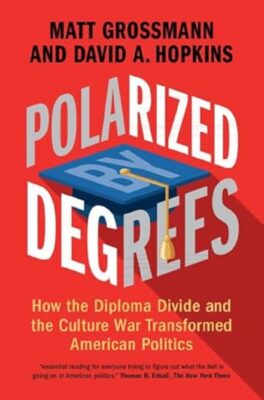
Polarized by Degrees: College and American Politics

Readers know I do a monthly book roundup, where I write briefly about 4 or 5 books I’ve recently read. But every now and then, I find myself wanting to say more about a particular book. Polarized by Degrees by Matt Grossmann and David A. Hopkins is one of those.

For one, it’s timely. Most of us know there’s something wrong with U.S. politics, even at the level of everyday discussion. Things get heated and contentious. Many Americans – particularly members of marginalized groups – feel unwelcome in their own country. And we see rising levels of hate crimes, often with politicians openly egging them on.

This situation leads some of us to look for the source of the unrest. What divides us?

According to the chattering classes, especially pundits, identity forms the dividing force. We see this from both progressive and conservative ends, with the former blaming racism and/or toxic masculinity and the latter blaming the ‘woke mind virus’ or some such. It has gotten to the point where I use the term ‘identitarianism‘ to get at the assumption shared by both progressives and right-wingers that politics and/or political explanation reduce to identity.

After the dust settled from the 2024 election, people combed through the data to see how the vote broke down by demographic groups. And, of course, they brought their identitarian assumptions to the table. They wanted to know how race and gender drove the vote. Because what else could have done it?

And so they brought out the standard playbook of questions. Did Harris lose because ‘ugh, white women again!’? Did she lose because black men ‘abandoned’ her?

In Polarized by Degrees, Grossmann and Hopkins suggest something else matters more than identity.

Continue reading

DNC Steps on Own Dick, Again

After the 2016 and 2020 primary losses, many Bernie Sanders supporters argued that the DNC ‘rigged’ the primaries, costing the Bern the win.

The argument wasn’t a good one. DNC leaders certainly favored Hillary Clinton in 2016. And they certainly opposed Sanders in 2020, even if they weren’t necessary thrilled by Joe Biden. In 2016, in particular, there was even evidence that they put their thumb on the scales in certain ways.

As I’ve argued many times, though, the ‘rigged’ accusations amounted to excuse making from left and progressive electoralist camps. The biggest reason Sanders lost in 2016 and 2020 is that the left has been at a historical weak point for years. We haven’t yet done the base-building needed to become powerful enough for a credible presidential campaign.

But that’s not the point of this post. The point is that the DNC always manages to step on its own dick. Even when the things it does don’t really have a major impact, it always manages to look like it’s engaged in some kind of fuckery.

Continue reading

Revisiting the Worst Political Issues

Three years ago, I wrote a post about the worst political issue for the GOP and the Democrats. After investigating the topic, I focused on balanced budges for the GOP and gun control for the Democrats.

What made those issues stand out is that there’s a wide gap between generic voters preferences and how strongly voters feel about the issues. Voters like balanced budgets in the abstract. But as soon as you turn to tax increases or spending cuts – how you balance budgets in the first place – voters are far less interested. And while many people like gun control, most have no direct experience with actual gun violence.

But it’s 3 years later. Let’s check in to see whether they’ve learned anything.

Continue reading

Two Definitions of ‘Working Class’

Just about everyone who tries to explain Kamala Harris’s loss loves talking about the working class. They point to Harris’s loss of the working-class vote as a starting point. And then they explain the decline of the Democratic Party’s electoral fortunes as a decline in their support among workers in states like Michigan, Nevada, Pennsylvania, and Wisconsin.

Of course, they draw very different conclusions from this starting point.

Bernie Sanders, for instance, explained Harris’s loss as a loss of support among black and Latino working-class voters. Others, more friendly to the professional classes, thought Harris alienated working-class voters by running too far to the left on social issues. But they shared a focus on loss of working-class votes in swing states.

At one level, that’s a fair enough starting point. Harris did lose the aforementioned states after Biden won them in 2020.

But the politicians and pundits glide through these debates without justifying how they define the term ‘working class.’ And it’s no mere academic debate.

How you define the word matters. A lot. Competing definitions put entirely different groups of people into the ‘working class.’ They thereby recommend very different strategies and tactics for bringing them back into the fold.

Continue reading

Rethinking Public Office as an Epicurean

I’ve argued in a few ways that a good Epicurean – and certainly an Epicurean sage – wouldn’t seek public office or a career in politics.

For Epicureans out there, it shouldn’t be hard to tell why. Politics fills our lives with stress and drama. It leads to exactly the kind of anxiety and mental anguish Epicurus advised us to avoid.

But I recently read an interesting set of essays called Epicurus and the Epicurean Tradition. In it, Jeffrey Fish plays devil’s advocate on behalf of Roman Epicurean politicians. To get there, Fish draws a distinction between desiring to participate in politics, on one hand, and reluctantly participating in politics because it’s the best choice, on the other.

In support, he also cites the work of Epicurean philosopher Philodemus. Philodemus’s work shows that Epicureans tolerated a wide range of professions among their practitioners. While the practice of philosophy and life among friends stood out as the Epicurean ideal, we find ourselves in many different life circumstances. Couldn’t even politicians practice Epicurean attention to tranquillity as an ideal?

Fish’s article didn’t exactly dislodge from me the view that the Epicurean shouldn’t seek out public office. But it does serve as an important corrective in some respects.

We shouldn’t be dogmatic in deciding, a priori which professions are OK and which aren’t. It’s entirely possible that a person finds themself in a situation where holding political office is the best way to promote tranquillity, both for themselves and for their friends and community. It’s also possible for even people who work in inadvisable professions to incorporate Epicurean insights into their lives.

On reading Fish’s article, I thought these were fair correctives. The Epicurean sage wouldn’t become a politician, but we can all benefit from incorporating Epicurean insights.

No matter our starting point.

Image Source
« Older posts Newer posts »