Alienation, autonomy, and ideology

Category: Corporate World (Page 6 of 14)

These are posts on the corporate world from the blog Base and Superstructure. The corporate world is complex. It’s confusing to anyone not involved. Corporate life has its own characteristic forms, language, jargon, and mannerisms. Neoliberalism structures our politics and thought, and so this is also a major focus of these posts. The non-profit corporate sector is its own distinct mini-world. And, in particular, spending significant time involved in corporate life engenders a special form of ennui. All of these subtopics feed off of one another. Each is critical to thinking about corporate life and its role in the United States.

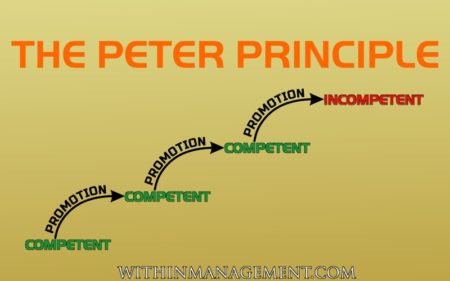
Corporate Politics 101: The Peter Principle Now

I think quite a few old timers know about the Peter Principle. But for anyone who doesn’t, the basic idea is that people keep getting promoted for doing a good job until they get to a level in the corporate hierarchy where they can’t do a good job. And so, they stagnate at that level. Stated simply, the Peter Principle says that people ‘rise to their level of incompetence.’

Neat trick, right?

Does it still work in the 2020s? Sort of. The major difference now is that people rarely stick around at the same company long enough to fulfill the Peter Principle. At the very least, they spend only a few years at their level of incompetence. Maybe they stick it out for 5-10 years. And then they make a parallel move to a new company!

That shows the need for an updated Peter Principle. When people hit their level of incompetence, they go to a new company and perform the job incompetently over there.

What’s fun about today’s corporate world is that HR plays directly into this. By requiring years of experience in a job to get hired into that job, HR discourages good employees from applying for a promotion into a job they might do well. Instead, they hire experienced, but mediocre, middle managers and project managers.

Go figure.

Image Source

Corporate Politics 101: Office Space Was Right

I think most Americans over the age of 35 watched Office Space at some point. But quite a few of my readers are under 35 and missed it. So, yeah, the film’s 20+ years ago. Maybe some of the references strike us as dated. But the movie sure was right. About more or less everything.

Office Space talked about bullshit jobs well before Graeber got around to it. The characters in the film still exist in many companies. And as for the basic corporate structure – the way companies divide between competent workers and foolish leaders? Yeah, it still works about like that.

And so, I’d highly recommend readers watch Office Space again (or for the first time). It goes well with some of my posts on corporate ideology and on the Great Resignation. It sheds lots of light on the white-collar world.

Image Source

Corporate Politics 101: Be Nice To Staff

I focused in 2021 on issues in the business world and corporate culture. Along those lines, I’m going to write a new series of posts for the new year. It’s called Corporate Politics 101. The  thought: I’ll lay out some basic tips for how to navigate the business world. Along the way, maybe we’ll learn a few interesting things about the politics of the business world.

Corporate Politics 101 #1: Be Nice to the Admin Staff

A few years ago, I sat down to eat lunch in one of our office lounges. While having lunch, I found the credit card of an admin assistant lying on the floor near one of the seats. I picked it up and returned it to her.

That’s it. Nothing more to it. What’s so important about this?

For one, it was just the right thing to do. Solidarity with your fellow worker and human being, and all that. But, two, admin assistants are usually nice people who work hard for not enough pay. They also – perhaps more than anyone else in a company – make things run smoothly.

Lately, the corporate world has been learning that latter lesson the hard way. Due to various business ideologies and systems, they’ve chosen to lay off quite a few admin assistants. And without admin assistants, they have to load admin work on various executives who, frankly, have neither the skills nor the inclination to do the work well. In such an environment, one would be well advised to be nice to the admin assistants who remain.

They’re your best friends on the job!

The Series

So, that’s the first post in our Corporate Politics 101 series. I’ll try to keep the posts short and sweet. How often will I write them? I don’t know. Whenever the mood strikes me, I suppose. I’ll probably work these posts into my regular, shorter posts on Thursdays.

Image source

The Problem(s) with LinkedIn

LinkedIn has a lot of haters these days. Why? According to critics, it combines the worst features of Facebook (lack of privacy, mindless chatter) with the worst features of the business world (corporate politics, self-promotion, professional class propriety). To boot, LinkedIn doesn’t even do the things it’s supposed to do, i.e., it usually doesn’t help you network or land a job.

I’ll admit I don’t know exactly what’s wrong with LinkedIn. I just know it sucks and I don’t like using it. Do I still have a LinkedIn account? Yes. Will I get rid of it? Probably not. But I rarely use it, and I don’t expect that to change.

Continue reading

‘Thought Leader’: A Business ‘Intellectual’

Not long ago, I watched a LinkedIn video that defined a ‘thought leader’ as “a person who helps people make difficult choices by being a decision leader.” As a philosopher, I wasn’t too impressed with this display. And as a definition of ‘thought leader,’ that’s about as unhelpful as it gets.

But I think it shows us a few things about business jargon and the nature of the ‘business intellectual.’ What does it show us?

Continue reading

« Older posts Newer posts »