Alienation, autonomy, and ideology

Category: DSA (Page 1 of 8)

A Popular Front Against Trumpism?

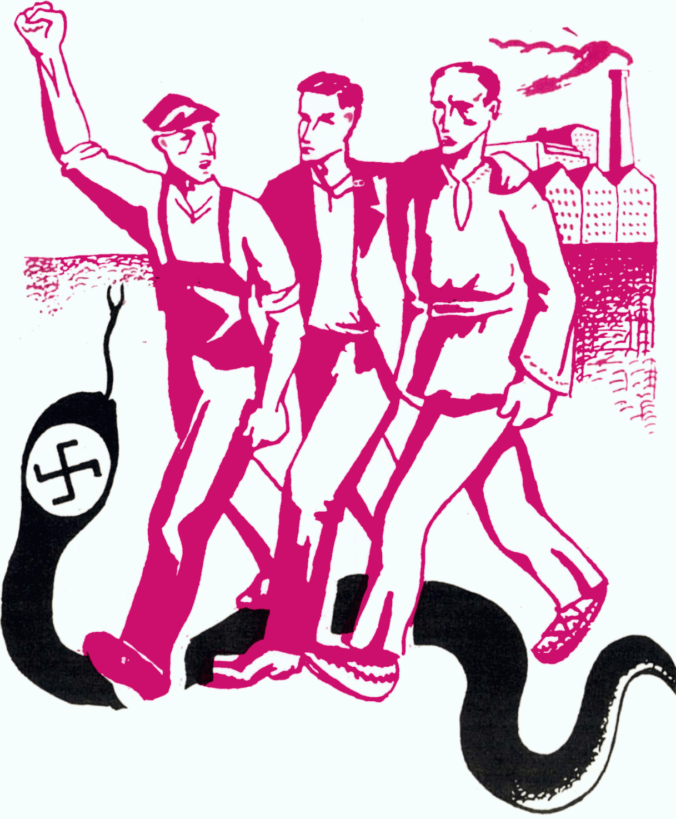
In The Great Fascism Debate, we see the emergence of a rough analogue to to the Popular Front of the 1930s. In listening to people tell it, it goes something like this: a grand coalition of leftists, progressives, liberals, moderates, and soft conservatives must come together to fight the great authoritarian right threat of the 2020s.

Readers of my previous work won’t be surprised to find that I greet this claim with skepticism.

It’s not that the authoritarian right doesn’t pose a threat in the 2020s. Rather, it’s that I’m already well on record pointing out that the threat in the 2020s doesn’t look much like the one from the 1920s to the 1960s. However, I also think, for quite different reasons, that a ‘Popular Front’ is the wrong frame. That kind of alliance today holds little potential to help the left achieve its goals.

Let’s focus on that.

Continue reading

DSA’s Special Interest Problem

Here’s a common story about what happens when someone joins DSA.

A politically engaged person arrives who cares a lot about one issue or approach. They join DSA to work on their special interest. As they join, they engage in a flurry of activity around their special interest: signing up with a national working group devoted to it, pushing their chapter to work on it, writing a Convention resolution about it, and so on.

In many cases, it ends badly.

Perhaps the Convention votes down the resolution about the person’s special interest. Perhaps no one else in the person’s chapter is interested in the topic, or the chapter takes a different approach to it. Or perhaps fights and feuds tear apart the national working group. Even if none of those things happen, the person might just burn out from putting all their time and effort into a single topic.

They leave DSA in a huff.

We see this story with a wide range of special interests. I’ve seen people go through this process on mutual aid, the Green New Deal, Palestine, disability justice, trans rights, Medicare for All, and other issues of note.

And so, I think DSA has a ‘special interest’ problem. I’ll also say a word about what do to about it.

Continue reading

A Better One Question Political Test

In a recent post on local politics, I said it’s a bad idea to reduce local politics to things under the ‘abolition’ label. More generally, it’s a bad idea to reduce politics to any single issue.

People often look for shortcuts. I get that. But if you’re going to do so, find a better shortcut.

Our local DSA chapter used a long questionnaire for 2025 city council endorsements. Some of the questions are redundant, and many don’t apply to local elections. But sometimes this happens in a democratic org. Anyway, one question reads as follows: “What do you believe is the root cause of the housing crisis, and how would you seek to address it in office?”

That’s a great question, and it makes for a better single issue test. Why? For one, housing stands out as the most important issue in Iowa City politics. People who earn average incomes can’t afford a place to live. Many are getting pushed out to Coralville, North Liberty, or beyond. But also, it’s an issue on which many people hold key misconceptions. YIMBY and NIMBY politics dominate our area, even among progressives and those who believe they’re ‘leftists.’

Having read the answers given by three candidates, here’s a handy guide to interpreting responses:

Candidate cites capitalism, finance capital, financialized capitalism, private equity, and/or neoliberalism: Correct Answer

Candidate cites housing supply: YIMBY

Candidate cites housing demand among individual buyers: NIMBY

Even though the three candidates we quizzed – Newman Abuissa, Amy Hospodarsky, Clara Reynen – slot into the same alleged ‘faction’ of local politics, only one came up with the correct response.

That candidate was Clara Reynen. The other two tested out as YIMBYs.

If you’re looking for a simple test, it’s this one. And Clara Reynen passed the test.

The Local Politics of Small Differences

We’re in the middle of a city council election cycle in Iowa City. Plenty of people are getting worked up about it.

In some ways that’s a good thing.

It means we live in a politically engaged city. And there are lots of issues for us to tackle. On top of this, the previous election – a special election between Ross Nusser and Oliver Weilein – offered deep, meaningful differences on how to run a city in a revanchist era. Its results emerged from a realignment of our local politics.

But this election strikes me in a different way.

At least four (and possibly five or six) of the six candidates aren’t very different from one another. They practice broadly similar politics. However, people think they’re different. This calls for a closer examination of the forces that push people to over-invest in local electoral politics.

Let’s do that.

Continue reading

Against Centralized Majoritarianism

A couple years ago, I listened to the Russian Revolution season of Mike Duncan’s podcast Revolutions. Readers might recall that I had a few things to say about the podcast when tsk-tsking Duncan about Marx on profit.

In fact, I think it’s overall a great podcast. And I listened to it again, this time hitting all seasons and not just the one on Russia.

As I listened to how the various revolutions strayed off course, I thought about how their leaders engaged with the population. That is to say, I thought about how the revolutionaries related to the average person in these societies. I especially thought about this in light of the French and Russian Revolutions, two revolutions that featured at least some conception of a society built in the interests of the people as a whole.

Continue reading

« Older posts