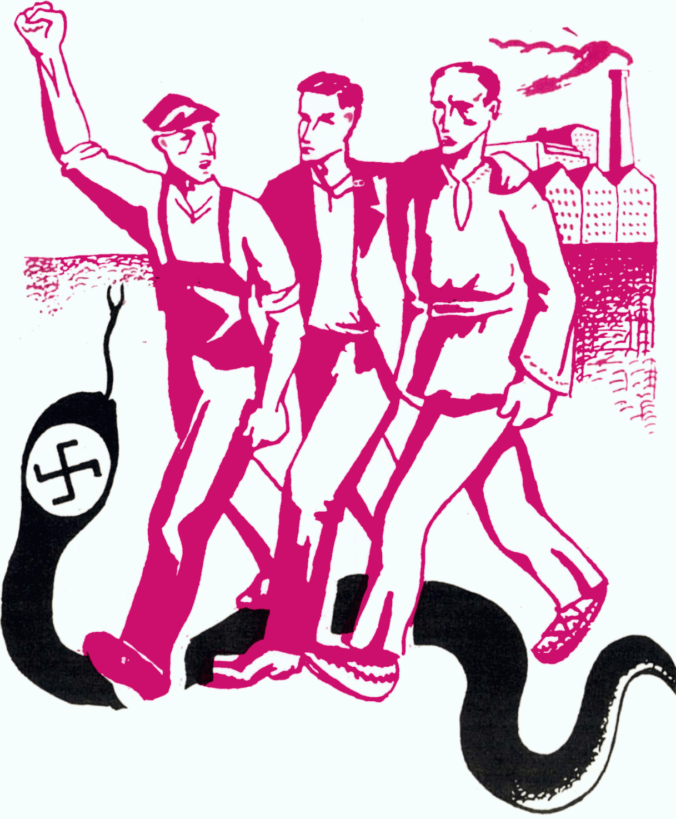
In The Great Fascism Debate, we see the emergence of a rough analogue to to the Popular Front of the 1930s. In listening to people tell it, it goes something like this: a grand coalition of leftists, progressives, liberals, moderates, and soft conservatives must come together to fight the great authoritarian right threat of the 2020s.
Readers of my previous work won’t be surprised to find that I greet this claim with skepticism.
It’s not that the authoritarian right doesn’t pose a threat in the 2020s. Rather, it’s that I’m already well on record pointing out that the threat in the 2020s doesn’t look much like the one from the 1920s to the 1960s. However, I also think, for quite different reasons, that a ‘Popular Front’ is the wrong frame. That kind of alliance today holds little potential to help the left achieve its goals.
Let’s focus on that.
Catalyst
In an article in Catalyst, Steve Fraser argues against the notion of leftist participation in a new ‘Popular Front.’ He does so on the grounds that it’s far less likely to go well for the left in the 2020s than its successes in the 1930s.
On Fraser’s reading, the left actually led the Popular Front for much of the time in the 1930s. It did so on the strength of a power base in labor. And it made strong gains on the basis of this winning power base. Among other wins, Fraser attributes much of the New Deal to a left-led Popular Front.
By contrast, the left is much smaller in the 2020s than in the 1930s. It lacks the deep ties to organized labor that served as the basis for those wins of nearly a century ago. As a result, Fraser thinks any new Popular Front would lack left leadership. Instead, it would build itself on the basis of centrist and center-right power.
Centrists and center-right powers, of course, hold no interest in achieving leftist goals.
Last Time and This Time
That’s how Fraser’s argument goes, anyway.
Admittedly, I’m less rosy about the 1930s Popular Front than Fraser. It’s not that I think it was a bad thing. Rather, I don’t think it had the leftist leadership Fraser attributes to it, and I don’t think it directly led to major legislative accomplishments on leftist priorities. The left got a ton of things done in the 1930s – notably Social Security, as well as a wide range of social, political, and economic advances – and it did these things via a strong labor movement.
But the Popular Front didn’t play a primary role in that. Instead, the Great Depression played that role. Capitalists joined a class coalition with a strong labor movement. This coalition created Social Security because it helped both sides. For capitalists, it helped stabilize the system and stave off economic collapse and riots. For labor, it helped bring workers out of poverty. And, frankly, for both sides, it pushed workers away from Communism.
And so, the Popular Front wasn’t quite as great for leftist goals as we might think. In today’s world, we would reasonably expect even lower chances of leftist gains. Given the relative weakness of our organizations – and our disconnection from organized labor – it would quickly degrade into a centrist-led Vote Blue No Matter Who/Lesser Evilism approach.
Surely I don’t need to convince readers yet again that this won’t do anything for the left.
And so, we should fight the authoritarian right in the 2020s. But we need new ideas and new frames, not more retro 1930s talk.
