Alienation, autonomy, and ideology

Category: Philosophy (Page 9 of 11)

These are posts on philosophy from the blog Base and Superstructure. My background is in academia, with a specific focus on feminism, philosophical issues in the social sciences, and social and political philosophy. I have also done work on historical figures such as J. L. Austin and Ludwig Wittgenstein. These posts incorporate some or all of these issues. The influences may be more or less explicit, depending on the topic. Philosophy can be intimidating, and so these posts present issues in a way that’s open to many people. There is also discussion of specific philosophical issues, and specific issues from a philosophical perspective, such as feminist accounts of pornography, Marxist and socialist accounts of the state and political economy, and the search for the best explanations for social and material phenomena.

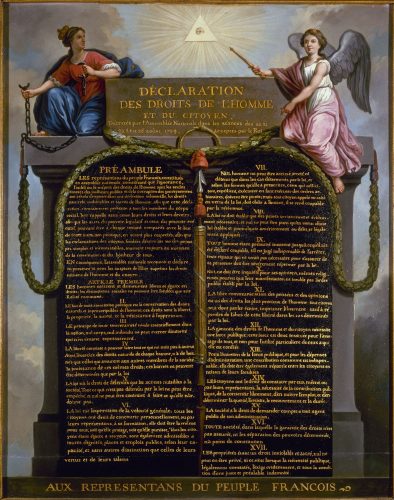
Karl Marx and the ‘Rights of Man’

Rights of Man Marx

It’s a bit trendy these days for leftists to dismiss talk of ‘human rights’ – or the ‘rights of man,’ as people once knew them. In truth, Marxists went even further. But it’s surging again in the last few years. In the older days, leftists dismissed all this as talk of ‘bourgeois rights’ or ‘freedom.’ Now they frame it more in terms of privilege or the ‘rights of man’ being only for white…well, men.

Where did all this come from? I’ll give an overview of Marx’s critique of human rights and the rights of man. This stuff comes from his early political philosophy. And I haven’t written a lot about that. I’ve focused in this blog mostly on Marx’s later work.

Continue reading

One Question About Heideggerian AI

I’ve been interested in questions concerning artificial intelligence (AI) for a long time. Back in the days way before I left academia. In my undergrad days at Indiana University, I even began as a Cognitive Science major. But the more I thought about these issues, the more I realized I was really interested in more philosophical questions about mind, meaning, and human understanding. Less so the science of AI. Eventually this led me to the work of Hubert Dreyfus and Heideggerian AI, Dreyfus’s application of the philosophy of Martin Heidegger to the field.

But I’m getting a bit ahead of myself.

Continue reading

The Looping Effects of ‘Bisexual’

After the 2004 US election, pundits – and college students like myself – went looking for answers. How could Americans re-elect a buffoonish warmonger like George W. Bush? Over the course of a decade, this search guided me from pundit-generated pablum like ‘NASCAR Dad‘ to the philosophically compelling ‘looping effects of human kinds’, as Ian Hacking put it. Let’s trace that journey.

What struck me about the punditry is their attribution of an ordinary event – the re-election of a president – to hidden, mysterious forces. Who were these NASCAR Dads riding to Dubya’s rescue? As it happens, they’re no one new. Lifting up the hood reveals the same white, mostly male, non-college educated voters who elected Reagan in 1980 and Trump in 2016. They vote Republican in every election. ‘NASCAR Dad’ is only a seemingly fresh take on an old story, loaded this time with cultural references.

But I drew lessons from getting burned by bad punditry and bad political science. Through works like ‘Making Up People‘ and The Social Construction of What?, I found philosophers doing great work on classifications of people and how people react – the ‘looping effects’ of my title! And so, I’ll start there. What are ‘looping effects’, and how do they apply to the term ‘bisexual’? Does it mean people aren’t really bisexual, just as people aren’t really NASCAR Dads? Or are NASCAR Dads real after all? Is there some ‘authentic self’ prior to how we’re grouped?

Continue reading
Donald Trump: The Character

“Donald Trump looks and sounds like a professional wrestling character.” People say this figuratively, but they should mean it literally. He looks and sounds like a professional wrestling character because he is one. In fact, the WWE elected him to its Hall of Fame in 2013. His wrestling character isn’t the whole story of Trumpism, but it’s a major part.

Let’s explore that, shall we?

Continue reading

« Older posts Newer posts »