And so, we’ve hit the end of the year. This is our final reading list for 2025!
Read on to see what I’ve been reading at the end of 2025. And, as always, let me know what you think and what you’re reading as we wrap up the year and head into 2026.
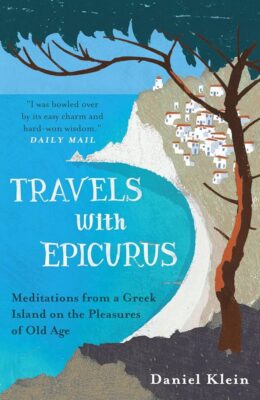
Daniel Klein – Travels with Epicurus
Klein sets off for a Greek island to contemplate old age, bringing with him a pile of philosophical books and a rich life story.
As a central theme, he sets himself in opposition to those Boomers who aim to remain ‘forever young.’ The trend among older Americans has been to try to deny old age. They try to accumulate wild new experiences and, in general, live like a person decades younger.
Klein acknowledges a bit of wisdom in that. But he finds greater wisdom in accepting a slower pace of life as one ages. He thinks we should accept that a life full of novel experiences isn’t really the best sort of life, especially as one ages. We should instead take delight in something simpler and more widely accessible.
And in that point, Klein rightly draws wisdom from Epicurus. In addition to Epicurus, he also finds worthy points from existentialists and Stoics. And while a little volume such as this one isn’t going to make novel philosophical contributions, I do think Klein applies those lessons well to his experiences.
The book also functions as a travel journal through Greece, which is always nice. An incident Klein encounters on a train that circles the Peloponnese – where he has a conversation with a conductor as two trains are stopped to allow him to switch – is especially noteworthy.
All in all, it’s a short and breezy book worth reading.
Nnedi Okorafor – Death of the Author
This is the third book my reading group tackled. For this one, we decided to do a sci-fi month, and this looked like it qualified. In the end, it…sort of did. It’s not quite a sci-fi book, but it does something interesting with the topic. It’s about an author who writes a sci-fi story, with quite a twist at the end.
So, what sort of book is it? It’s an exploration of a Nigerian family, particularly its disabled daughter and her struggles to establish herself. The main character plays the role of someone simultaneously privileged and disadvantaged. Both the book and her ‘fiction’ story play on that combination. Along the way, yes, the book tells a sci-fi story that ties the main character to cyborgs and robots.
It’s different, and mostly in a good way. I enjoyed it as a departure from the usual sci-fi I read.
John Scalzi – The Shattering Peace
Finally, we’ve got the long awaited new book in Scalzi’s Old Man’s War series! I wrote about the rest of the series in the October reading list. Now let’s move on to the latest.
The new book picks up right at the point the last book left off. Two groups of humans – along with an alien federation – relate to each other with an uneasy peace. The point of departure for this story is that the Consu, a far advanced alien race, intervene in a way that tips the balance. The book tells the story of a character who is uniquely positioned to handle the Consu.
How was it? It was a well told, tightly focused story. Scalzi really strips this one down to just the main character and her surroundings. In one sense, this made it a very quick and compelling read. In another sense, though, it left me wanting more. The first couple of novels in the series are longer and more involved. By contrast, I knocked this one out in a few days.
I’m excited to see what comes next in the series.
Alan Siegel – Stupid TV, Be More Funny
This is one of those books that was a pure joy to read. Siegel gives a history of the early context and details of The Simpsons, my favorite TV show and probably the most influential show of the 1980s and 1990s.
Probably any Gen X or Millennial reader would be interested in this, and so there’s little reason to explain why someone might want to pick it up. But I think the most valuable parts of the book were the descriptions of the writing process and the background politics that allowed such an innovative show to come about at this particular time.
The book doesn’t disappoint.
Edward J. Watts – The Final Pagan Generation
A couple of years ago, I read Watts’s book City and School. I thought it was a fantastic history of the late Roman educational system. And as I explained then, Watts was my Roman history professor at Indiana University in the early 2000s.
This book, too, tells a great story. And this time, Watts covers the 4th century. He follows out the path of Romans born in the early 4th century under the tetrarchy on through to the new Christian Empire. As Watts tells it, the Roman system – from educational networks to traditional religion and civic culture – gradually breaks down over the course of a couple of generations. But it does so in a way that’s far more noticeable to younger people than to the ‘final pagan generation’ of the book’s title.
We see a gradual, organized attempt to build a Christian Empire over the structure of the old system. Under Constantine himself, the attempts are hardly even noticeable. Watts carefully documents how hundreds of thousands of pagan temples continue to thrive into the Constantine era.
From there, we see a series of moves by Christians to push it forward. And we see counter-moves by traditional Roman religion to push back. Constantius attempts to ban sacrifices and destroy temples, but Julian the Apostate restores temples and sacrifices. An era under Jovian, Valentinian, and Valens becomes more conciliatory. And then Theodosius and following emperors move even harder against pagans.
To liven the story, Watts follows particular figures, such as Libanius, who were born in the early fourth century and have to navigate each successive wave.
While I still think Watts comes off as too sympathetic to Christianity – and somewhat downplays their violence against non-Christians – the history he tells is excellent and informative.

Leave a Reply