We’re in the middle of a city council election cycle in Iowa City. Plenty of people are getting worked up about it.
In some ways that’s a good thing.
It means we live in a politically engaged city. And there are lots of issues for us to tackle. On top of this, the previous election – a special election between Ross Nusser and Oliver Weilein – offered deep, meaningful differences on how to run a city in a revanchist era. Its results emerged from a realignment of our local politics.
But this election strikes me in a different way.
At least four (and possibly five or six) of the six candidates aren’t very different from one another. They practice broadly similar politics. However, people think they’re different. This calls for a closer examination of the forces that push people to over-invest in local electoral politics.
Let’s do that.
Issues and Candidates
There’s disagreement among Iowa City residents – and curious observers who live nearby – over what, exactly, the key issues are. Of course, that’s normal. We find it in every city.
But any sensible list puts the affordability and accessibility of basic goods – especially housing – at the top. Gentrification and financialization of housing make it incredibly difficult for any adult with a normal, working-class income to afford a place to live. Though this affects many cities, our large, transient student population adds a layer of distortion that goes beyond most places.
Our list should also include issues of how to steer the local ship of state in an era of far right control at the federal and state levels. This includes whether and how to fight the feds and governor. But it also includes how to find new ways to fund and sustain the city in an era of chaos and declining federal budgets.
One interesting part of this latter issue – one that I focused on in my previous article on realignment – is that it opens the door to social democratic ideas the city has long overlooked. In addition to being the correct path for the left, social democracy also helps a city fund itself sustainably. This includes public banks and mixed income publicly owned housing, among other ideas.
But the candidates mostly agree on these issues. And they approach discussion from a similar background. Differentiating them requires setting these key issues aside. Instead, the campaign focuses on small differences on other issues – much to the detriment of leftist goals.
The Narcissism of Small Differences
Local politics in Iowa City have gotten testy. At times, this shows up among the councilors. Given that they agree with each other so often, I find this mysterious. But since most don’t find this mysterious, I’ll say a bit about why I do.
Many in Iowa City see on the council a split between a majority of 4 and minority of 3. I recently called it the ‘two factions‘ model. The majority represents a ‘sensible’ or ‘conservative’ faction, depending on who you ask. And the minority represents a ‘progressive’ or ‘utopian’ faction, depending again on who you ask.
But when I look at our current council, I see six and a half liberal to progressive Democrats.
Six of the seven council members slot, ideologically, as liberal to progressive Democrats. The seventh (Weilein) slots as a socialist, but he’s pragmatic and willing to work with others. The way issues get framed puts him in the position of behaving like a progressive most of the time.
Not much difference in that.
With that said, our councilors aren’t identical to one another.
Mazahir Salih, in particular, brings to the table a working-class immigrant constituency and close attention to the grassroots level. Other council members bring their own particularities. But any such particularity stands against a large background of agreement. On the core issues I identified above, they move in step the vast majority of the time.
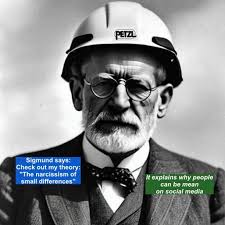
Freudians no doubt recognize in this the ‘narcissism of small differences.’ In short, a small political body with so many similarities develops a hypersensitivity to minor differences. They blow those things up into a distorted image of how politics work.
While I’m no Freudian, I think something like this stands behind the ‘two factions’ model of Iowa City politics.
But Why, Though?
It’s not enough to just drop a bit of Freud and call this a sibling rivalry. Why is it happening in Iowa City now?
I see three main causes.
First, for many years, we’ve lived in an era of working class disorganization. The institutions that built and sustained working-class solidarity are in a state of advanced decay. The ones that remain show little interest in rocking the boat. And while a few local orgs have tried to counter this, nothing has stuck. Iowa City’s relatively small working class (compared to other places) also further erodes the possibility of non-electoral action.
This drives people to electoral politics when they might have otherwise done something more useful, such as getting involved in labor and/or tenant unionism.
Second, far right domination of federal and state politics leaves many Iowa Citians feeling like those things are out of their control. And so, not only do they focus on electoralism, they do so at the local level. The federal and state levels feel hopeless.
Third, due to the need to highlight any difference they find, many in Iowa City push to the front issues they put under the label ‘abolition,’ including local police budgets and a new local jail, as their key point of local political analysis. That’s one of the few areas where we really do find a split between the two (alleged) factions. This makes it very attractive to package issues in this way.
A Rational Decision?
We have a story about why local politicos embrace a politics of small differences. When unions and other workers’ orgs are on the retreat and federal and state politics look bleak, local politics stand out. And in the absence of class and ideological conflict, we emphasize whatever disagreement we find.
But there’s also the question of whether it’s rational to go down this path.
I’ll give a mixed answer.
I’d encourage anyone on the left to pull back and better situate ‘abolition’ within our local politics. There are important issues under that banner. But for most Iowa City residents, they’re not the top issues. Nor do council member views on these issues translate to what they say about other issues. So, the term isn’t very useful for analysis.
This calls for a different frame. ‘Abolition,’ as both alleged factions in Iowa City politics put it, doesn’t do what they want it to do. For my part, I situate these issues within city sustainability. They get at what kind of city we want to live in and how we address social problems – whether we take a punitive attitude or a more collaborative one.
But housing, community issues, and social democracy should sit at the center of our politics. That’s what most people care about, and it’s what deeply affects most Iowa Citians.
On the question of electoralism, I think it’s perfectly rational for many individuals to turn to electoral politics in the present environment. We don’t all have the time or opportunity to form a union. For some of us, electoralism makes sense.
With that said, leftist orgs should, in my view, try to do whatever they can to create and build workers’ orgs. At the org level, we need to see less electoralism and more class formation.
Iowa City’s 2025 City Council Election
Near the beginning of this post, I suggested that (at least) four of the six council candidates aren’t very different from one another.
Readers might have guessed which candidates I have in mind. But in case it’s not clear, those candidates are Megan Alter, Shawn Harmsen, Amy Hospodarsky, and Bruce Teague. Even though three of them sit on one alleged ‘faction,’ while one sits on the other, they mostly differ on ‘abolition’ issues. On the issues closest to the center of Iowa City, they look very similar to me.
As a quick illustration, readers might check out Harmsen’s big list of activity from his previous term. I’d be hard pressed to identify much on the list that his opponent in District B, Hospodarsky, would disagree with. Even her method of approach to this stuff seems like it would be similar.
And this is supposed to be the race that determines factional control. But to me, it seems like a low stakes election. Both candidates seem to me highly qualified and similar in terms of basic approach and outlook.
There’s some uncertainty around the other two candidates – Clara Reynen and Newman Abuissa. They might present more contrast. But from the left, I don’t see any need to jump in and focus efforts on supporting or opposing candidates. I haven’t even decided who I’m voting for, though I’ve made some progress toward that decision.
Rather than nitpick the candidates, I see for the left an opportunity to press for the kinds of social democratic ideas opened up in the early 2025 special election and our current revanchist era.
I see the opportunity to push for social democracy at the local level.
