As we move through the fall and to the end of the year, I’ve put together an eclectic group of books this month. For readers looking for variety, this will be a great list.
Read on for this month’s list.
Ross Barkan – Fascism or Genocide
Barkan organizes this compact series of essays around themes from the 2024 campaign. The title’s ‘fascism or genocide’ refers to the view that Joe Biden and the Democrats moved so far to the right on foreign policy that the election had, indeed, become a choice between Trump’s fascism and Biden’s genocide.
Early essays begin with the roller coaster of early 2020s US politics, especially that of The Squad. Barkan points to how they rode to power on a wave of anti-Trump sentiment. And then several rolled out of power as the backlash set in. Why? To a large degree, they existed within liberal bubble spaces.
From there, Barkan mercilessly critiques Democrats for covering up Joe Biden’s infirmities. And he assigns much of the blame to Democratic consultants. At one point he divides Democrats into the ‘Palestine Left’ and ‘Blue Liberals,’ with the former flattening politics to a single foreign policy issue involving a single country and the latter mindlessly focused on lionizing corporate Democrats and promoting Rachel Maddow style conspiracy theories.
He brings it to a close with a couple of essays on US culture and the 2024 election. Particularly noteworthy is his contrast between Bernie Sanders and AOC. He reads Sanders as a diehard social democrat to the end and and AOC as a bit of an opportunist in her embrace of the Kamala Harris campaign.
More than anything, Barkan provides a view of the background in which US politics swim in the early 2020s. In that respect, it had roughly the quality of a time capsule.
Liz Moore – The God of the Woods
A local reading group I joined tackled this one as its second book. Much like the previous novel, it’s a crime and mystery drama. And much like the previous novel, it’s set near the Adirondacks in New York.
But I found it to be a more interesting story.
This one centers on the mystery surrounding the disappearance of a camper from a summer camp. As the story unfolds, it expands to include the unsolved death of the camper’s brother more than a decade before the current drama.
Moore tells the story through a large cast of characters in and around the camp – the campers, the police working to solve the case(s), the family that runs the camp, and people who live in the nearby working class town. It focuses on the broader environment, centering on a class divide between the wealthy people who run and attend the camp versus the working class people who live in the town.
As I read, I noticed common themes between the two novels. Ultimately I chalked these up to common genre themes. But I found those themes more natural in this novel than in the previous one.
And the solution to the two dramas surprised me. It drew heavily on the advantages and disadvantages of being a wealthy woman in the 1960s and 1970s. Along the way, Moore explores issues of gender and sexuality in a prior generation.
Richard Pipes – Three “Whys” of the Russian Revolution
I hesitated to put this book on the list, because it’s one of the worst books I’ve read in some time. Perhaps I can save readers from wasting money on it.
What’s wrong with it? We could start by pointing out that the book is mostly a collection of right-wing interpretations of the Soviet era, including some real howlers. But even beyond this, it’s a short summary of the author’s much longer works. Chopping it down to under 100 pages makes it disconnected, nearly incomprehensible, and nowhere near sufficient for the subject matter.
Any reader who doesn’t already know most of what happened in the October Revolution would be lost.
I didn’t include a product link on this one because I’d encourage you not to buy it.
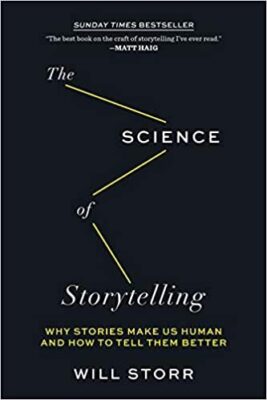
Will Storr – The Science of Storytelling
Storr provides advice on how to write a good story, but he wraps it in scientific chat about how people process stories and narrate their lives. I think Storr’s vision was to bolster good storytelling advice with scientific evidence that guides and contextualizes the advice.
When it works, it works reasonably well. He provides solid storytelling advice. Storr clearly understands how to tell a story that draws in readers – focus on change, center the story on compelling characters with realistic flaws, choose plots that complement the characters, center questions and mysteries about the characters’ true natures, and so on.
The science part works…less well. It’s often cursory and superficial. It gets in the way as often as it enlightens. His appeals to social and evolutionary psychology particularly fall flat.
But with that said, I learned some things from this book.
Sarah Wynn-Williams – Careless People
In theory, this is a memoir. But it was advertised as an insider account of Facebook in the early to mid-2010s. In practice, the ‘memoir’ portion runs for about 15 or 20 pages. The rest of the book is, indeed, an insider account of Facebook in the early to mid-2010s.
What do we get? We get the perspective of an idealistic young woman from New Zealand who creates a new job at Facebook to join a mission of saving the world. Bright eyed and ready for the challenge, she eventually endures a trip to a remote part of Malaysia, sexual harassment from her boss, harassment of some kind or another from Sheryl Sandberg, and any number of shenanigans involving Mark Zuckerberg and world leaders.
And, of course, we see all of Facebook’s problem with content moderation and political mischief.
Along the way, Wynn-Williams endures multiple medical issues around pregnancy and childbirth. Perhaps the most striking thing about Silicon Valley is its utter lack of preparation in dealing with anything HR related. One highlight of the book is how Sandberg used the company and its employees as a promotional team for her book, Lean In.
Is it a good book? It’s fine. I learned things about Facebook and the mid-2010s social media era.
That said, it’s basically the personal recollections of one witness. It’s written like a piece of journalism rather than a memoir – certainly the writing style works for journalism, but it’s awful for memoir writing – but, of course, without adherence to journalistic standards. I think the author is reliable enough, especially when it comes to things she experienced directly. But I’d probably balance it with an outsider’s perspective.

Leave a Reply