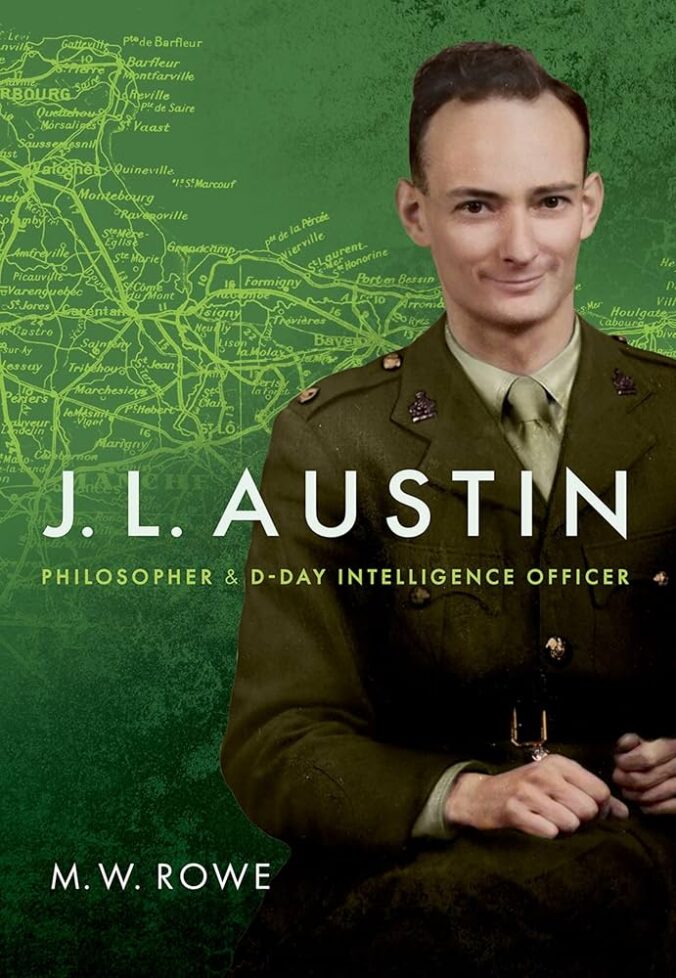
It’s unclear how many people want to read a 600 page biography of Oxford philosopher J.L. Austin. But count me among them. As an undergraduate, I made Austin’s paper ‘Other Minds’ the topic of my honors thesis. And even 20 years later, I’ve never lost the sense that there was something right about the method of ‘linguistic phenomenology’ Austin used in much of his work.
What was right about it? And how did it influence my own philosophical work? It can be difficult to say. I didn’t directly develop Austin’s ideas in my own articles and books. But my conceptual work begins from an understanding – we should situate philosophical concepts in relation to the everyday. This is to say that we must first understand – and only then expand upon or improve – ordinary notions.
As Austin put it, ordinary language is the first word.
On this blog, I’ve written a couple of reviews of books on Austin’s work. Readers can check those out here and here.
And so, with all this said, I was excited to read M.W. Rowe’s biography of the giant of ordinary language philosophy.
Background and Oxford
Rowe’s biography is comprehensive and goes back to Austin’s childhood and early days at Oxford. Austin excelled at classics, history, and philology. By contrast, he didn’t have much of a science education.
These things shaped his philosophical work. They guided his nuanced treatment of word use and enabled him to reach heights achieved by no other philosopher. At the same time, his education delayed and hampered his later turn to linguistics. And it left him less capable of engagement with logic and technical philosophy than he might have wanted.
Austin’s early open-mindedness and perceptiveness also stand out. He was a socially awkward man, but he formed close connections with others like him. He had a gay best friend who died in the war. And his friendship with philosopher and historian of ideas Isaiah Berlin lasted in some form for his entire life. Austin’s relationship with his sister, as well as other key women in his life, were arguably his most important connections.
Politically, Austin came to the moderate socialism of the Labour Party early in life and stuck with it.
Rowe covers his philosophical background as well. After the decline of British Idealism, in the wake of early analytic philosophy and logical positivism, Austin took influences from Oxford Realism and the ‘middle’ Wittgenstein.
World War II and D-Day
World War II intervened at the point where Austin looked set to rise. And this section of Rowe’s book probably taught me the most that I didn’t already know. In fact, I knew little about Austin’s involvement in the war, aside from the basic fact that he served in British intelligence.
As Rowe tells us, Austin played a key role in the D-Day Invasion. He led intelligence units that collected information on the number and position of Nazi forces. And he was great at it.
Moreover, he took what he learned back to Oxford after the war. Austin disliked his superiors and rivals, but he held affection and respect for those under him. And he organized small research and discussion groups to divide and tackle problems.
This formed the core of post-war Oxford ordinary language philosophy methods.
Ordinary Language Philosophy
Philosophy needed a new direction after the war. The horrors of mass warfare shook many philosophers out of the narrowness of early analytic philosophy and logical positivism. And ordinary language philosophy was well positioned to lead the way. It felt exciting to people, holding out the promise of addressing philosophical problems by clarifying concepts and terms.
Austin was its best practitioner. He loomed so large that he was arguably its only successful practitioner, though Ryle or the later Wittgenstein might quibble.
As Rowe tells the story, ordinary language philosophy combined pragmatism, attention to the everyday social world, and a Socratic method of questioning. With it, we could dissolve philosophical problems by attending to the uses of language, including its role in human action.
Austin stood out as a skilled teacher who attended to words engagingly enough to bring OLP to its height. Rowe analyzes in-depth Austin’s excellent paper ‘Other Minds’ and his methodological remarks in ‘Ifs and Cans’ and ‘A Plea for Excuses.’ These form the core of Austin’s linguistic phenomenology.
However, Rowe sees Austin’s most important contributions in the next stage of his research program. This amounts to a theory building project and the grounding of philosophy in action and linguistics. Austin’s posthumously published How to Do Things with Words summarizes this material.
Personal Life and Decline
Finally, Rowe sheds a great deal of light on Austin’s personal life. He covers his spouse and family, as well as an early affair with his sister’s nanny. Most surprisingly to me, Rowe covers how Austin’s career languished in his later years.
After reading Rowe’s description of how Austin treated potential rivals, it’s easier to understand why a book like Gellner’s Words and Things might have found an audience in its day and time. And after reading about Austin’s reluctance to publish, it’s easier to understand why ordinary language philosophy was so widely misunderstood – and not widely enough practiced.
For me, it helped contextualize why OLP never quite lived up to its billing, and why it still has so much potential.
Rowe’s telling of this personal story struck me as plausible. Had he lived into his 50s and 60s, Austin might have turned further toward linguistics. But I also wonder what would’ve happened had he followed up on papers like ‘Other Minds.’ Or had he done more to revise, publish, and promote his work from the later 1940s and early 1950s, particularly his remarks on methodology.
Regardless, Austin was a great philosopher. And Rowe does the few readers a great service by bringing out his story.

Leave a Reply