And we’ve arrived at fall! I’ll say a word about what I’m reading as the season turns. It’s a bit of a mix between pleasure reading, fitness, and philosophy.
Not the usual mix!
As always, let me know what you’re reading these days.
Peter Attia – Outlive
Attia, a former cancer surgeon and McKinsey consultant, jumped back into the medical field to study longevity. And he does so comprehensively, including quality of life rather and not merely the number of years.
This book introduces the rest of us to the tips and tricks of how to build a better life for longer. Attia’s answer? He says it’s important to intervene early, while a person is still healthy. And ideally we do so through a combination of exercise, emotional health, nutrition, and behavior. Furthermore, Attia emphasizes metabolic health. He sees it as important even to major illnesses such as cancer, heart disease, and dementia.
It’s an approach grounded as much in classical philosophy and psychology as in modern medicine. But it’s one that brooks no shortcuts and comes well supported both by the available science and by the testimony of those who live longer, higher quality lives.
On the whole, Attia’s advice is solid, and his book is well worth the read.
Christopher Beckwith – Greek Buddha
In this provocative book, Beckwith argues that ancient Greek philosopher Pyrrho picked up his key ideas from early Buddhism. He did so during his trip to India with Alexander the Great on his conquests. Along the way, Beckwith argues that much of what we think of as ‘Buddhism’ came about centuries later. It wasn’t a part of early Buddhism.
In support, he takes up the central ideas of Pyrrho’s philosophy and interprets them in a very Buddhist way. On Beckwith’s reading, Pyrrho argues that ethical matters are logically mixed and unstable. We should proceed from this fact to an attitude of indifference (apatheia) and tranquility (ataraxia).
On the whole, I find the argument interesting, even if I’m not in a position to evaluate its accuracy. At the very least, I think he presents a plausible picture of Pyrrho’s thought. He also provides tentative and compelling ways to connect Pyrrhonian skepticism to Epicureanism.
I suspect – along with many interpreters – that Beckwith overestimates the influence of Buddhism on Pyrrho and sets aside Greek influences. But even if so, this book still provides a compelling and fresh way to look at Pyrrhonian skepticism.
Lorraine Besser – The Art of the Interesting
Besser pulls together evidence from psychology to paint a fuller picture of the Good Life. She adds psychological richness to a more traditional view that includes happiness and meaning. In short, it’s not enough just to feel pleasure and meaning. In addition, a person needs to live a life that’s complex, novel, and challenging.
Philosophically, Besser interprets psychological richness as ‘the interesting’ – as sparking engagement with the world.
I think she plausibly lays out the features of ‘the interesting.’ And, indeed, it’s important not to lose oneself to mere positive pleasures or some kind of purpose of cause. We need experiences with the quality of perking us up, engaging us, and fulfilling our passions. She also gives us many useful tips on how to cultivate a psychologically engaged mindset.
Insofar as I had an issue with her thesis, it’s that I’m far less convinced that ‘the interesting’ is really something new. She distinguishes it from ‘pleasure,’ but in doing so, she leans heavily on the Cyrenaic notion of ‘pleasure.’ They read pleasure as a positive feeling that emphasizes bodily pleasures. But there are alternative traditions – Mill and, far more so, Epicurus – that think about pleasure in a way that likely includes ‘the interesting.’
Furthermore, insofar as ‘the interesting’ is a bad kind of engagement, it’s probably not a part of the Good Life at all. Instead, I suspect we should pick and choose among interesting things, with a focus on tranquility (the Epicurean advice) and/or positive, intellectual pleasures (Mill).
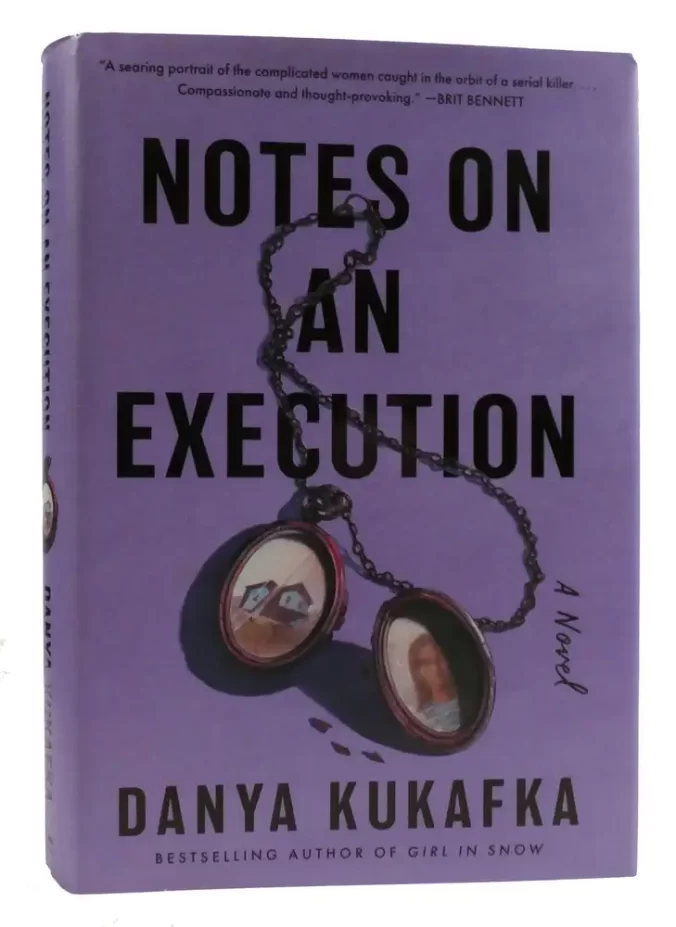
Danya Kukafka – Notes on an Execution
I read this novel as a part of a little informal book group that came together last month. That’s a new adventure for me, and I was excited to do it!
What we’ve got here is the story of a serial killer told through a few women who observed from the sidelines. They’re not his victims, but they’re closely connected to the victims and/or the killer himself.
Kukafka presents this as a novel take on the serial killer story. And I suppose that’s close enough to the truth. They present a portrait of the killer and his environment in a way that gets beyond some of the stereotypes and broadens the story. Multiple characters complain, quite reasonably, that serial killers draw all the attention out of the story.
That said, it doesn’t always work. I appreciate the attention to the side characters. But the portrait of the serial killer himself is one that I’d say draws on multiple stereotypes more than it actually transcends them. In addition to the ’emotionless killer’ stereotype, we also oddly get the ‘philosophy bro’ stereotype (he was writing a philosophical manifesto that somehow combines a Lockean theory of personhood, Sartrean existentialism, and Lewis’s modal realism).
I enjoy how Kukafka unfolds the story over time. She builds genuine suspense, even when we already know how it ends.
Penelope Maddy – What Do Philosophers Do?
In this collection of lectures, Maddy answers key questions about what philosophers do by taking a look at various philosophical responses to external world skepticism. And, as it happens, this is a long-time interest of mine – see here and here.
Maddy clearly and accessibly discusses key arguments about external world skepticism, focusing on the Dream Argument and the Argument from Illusion.
And while I appreciate her responses, she also has a knack for getting to the heart of the issues. For example, she points out that modern skeptics take Descartes out of his historical context. What started as a guide to an early modern transition of worldview becomes a global skeptical concern Descartes didn’t really share.
In line with my interests, I appreciate that Maddy sees J. L. Austin’s focus on the communicative function of the word ‘know’ and related terms. It’s perfectly fine to appeal to the world when asked how we know things, and, ultimately, global skeptical concerns never truly get off the ground. Furthermore, with the Argument from Illusion, Maddy’s reading of Austin shows how misuse of the term ‘material objects’ leads to bad results.
Finally, I appreciated Maddy’s methodological discussion in the final lecture. Drawing upon Austin, she shows that ordinary language investigation is most useful for everyday language with lots of nuance and subtlety, while conceptual analysis is more useful for technical terms.
This leaves me wondering which camp would better handle terms I use more often these days, such as ‘critical thinking.’
