A couple of months ago, I posted a retrospective of my work in academic philosophy. Primarily, that work concerned the use of practices as a fundamental unit of investigation in the social sciences and social philosophy. But I also had a lot to say in my work about labels.
My first book covered the topic extensively. In it, I laid out a three-part model of how labels interact with the people the labels pick out. And I explored a wide range of case studies in the social sciences and everyday life.
As it turns out, labels aren’t just inert, lifeless tags we place on something. They come to life. In many ways, classifying people isn’t like classifying rocks.
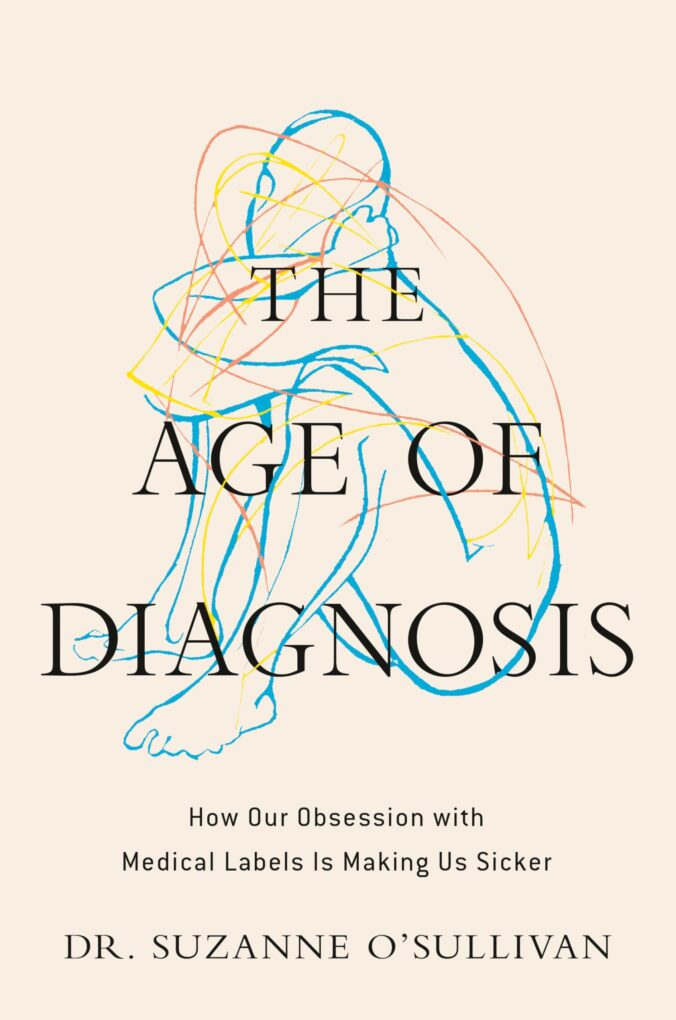
And so, I approached The Age of Diagnosis by Suzanne O’Sullivan with both excitement and trepidation. It promised to take on a topic very much up my alley. But it’s far easier to address this topic poorly than to do it well.
I shouldn’t have been so nervous. The Age of Diagnosis is very much worth a read.
The author is a neurologist who often treats patients who present with symptoms of psychosomatic illness. And in The Age of Diagnosis she brings her expertise to bear on a uniquely contemporary problem. She covers the vast, often problematic explosion in medical diagnostic labels.
Overdiagnosis and Excess Medicalization
Among both physical illness and mental illness, diagnoses are skyrocketing.
Why?
O’Sullivan points to a variety of possible causes. Maybe we’re just less healthy than we used to be. Alternatively, maybe our technological advances make us better at detecting problems that were always present. Or maybe we’re overdiagnosing mild symptoms and medicalizing things that are really just normal parts of everyday life.
O’Sullivan finds evidence for all three. But she thinks the third predominates.
In the mental health realm, psychiatrists repeatedly expand the list of labels and their diagnostic criteria in their main guidebook (DSM). And in the realm of physical health, advances in technology make possible earlier and earlier detection.
The upshot of all this is that doctors are diagnosing milder and milder versions of mental and physical illness.
In some cases, that’s a great thing. It’s wonderful to find out about a potentially deadly cancer long before it turns serious. Often it’s much easier to treat at these earlier stages. But in far more cases, doctors are diagnosing apparent ‘problems’ that, had they developed on their own, never would’ve actually caused serious illness. These doctors end up putting patients through hours and hours of unnecessary, harmful treatment.
Furthermore, O’Sullivan shows that many of these interventions don’t actually improve long-term health outcomes. For that reason, she calls this ‘overdiagnosis’ and excess medicalization of the quirks of everyday life.
Examples
She offers an incredible range of examples. These cover everything from physical illnesses with firm genetic criteria to murkier and subjective disorders with squishy ones.
In the former camp, O’Sullivan points to Huntington’s Disease. It has a single genetic marker whose presence guarantees illness – illness that’s incurable and eventually fatal.
And yet, even in this extreme case, the pragmatics of diagnosis are complicated. When people receive good counseling, many at-risk patients choose not to test for Huntington’s. They feel it’s better to live their lives not knowing.
And so, even here, routine testing might not be the best idea. The reactions of patients confounds the standard assumption in medicine that it’s better to test and know.
Autism and ADHD
From this case, O’Sullivan discusses a number of far more controversial topics. But she does so with compassion and reason. In a couple of chapters, she looks carefully at the neurodevelopmental disorders autism and ADHD.
These disorders lack anything approaching the conceptual clarity or objective diagnostic criteria of Huntington’s. Over the decades, psychiatrists have vastly expanded the definitions of both. And they’ve focused this expansion at the mild end of the spectrum.
As psychiatrists expanded the definitions, diagnoses skyrocketed. Indeed, symptom lists have grown so large and murky that many people now believe they have both autism and ADHD – two diagnoses once considered mutually exclusive.
Why did diagnoses skyrocket? The expansion of definitions has enabled clinicians to diagnose some who were previously overlooked. And this provided them with access to important care they lacked. But O’Sullivan believes they make up a small percentage of cases. For far more people, the diagnosis was put on them by doctors (or they diagnosed themselves), even though their symptoms are so mild that the ‘disorder’ requires no treatment.
‘Neurodivergent’ and ‘Neurotypical’
This becomes a problem, in O’Sullivan’s view, because labels aren’t inert. Putting the label ‘autism’ or ‘ADHD’ on a person, when they need treatment, is incredibly helpful. But putting the same label on a person when they don’t need treatment is potentially harmful. It exhibits what the philosopher Ian Hacking called ‘looping effects.’
In short, people placed at the extreme mild end who require no treatment can start showing psychosomatic symptoms that (somewhat) match those of people who have autism or ADHD. O’Sullivan also sees unintentional side effects, such as the domination of autism advocacy by people at the mild end of the spectrum whose work might prevent services from reaching people with more moderate or severe autism.
This gets at the heart of a tension in the neurodiversity movement. Some activists want two claims at the same time – both that they have autism and/or ADHD and that autism and ADHD are normal human differences rather than disorders. However, diagnoses are supposed to preclude these two things being true at the same time. A person with autism or ADHD has an impairment requiring treatment. And a person who doesn’t have an impairment shouldn’t be diagnosed.
O’Sullivan also picks at the label ‘neurodiversity’ itself. The problem, on O’Sullivan’s view, is that it’s defined in contrast to ‘neurotypical.’ But ‘neurotypical’ doesn’t really mean anything. There’s a huge range of normal variation. And very few people – hardly any at all – actually fit into the ‘neurotypical’ box.
I think that’s important and accurate. The fact of the matter is that most of us relate to the world in complicated ways that don’t line up very well. Some are more neurodivergent than others, yes. But hardly anyone is ‘neurotypical’ in a robust sense.
Potential Problem
But there’s one potential weakness in the way O’Sullivan lays this out. Psychiatric diagnosis once required drawing a causal distinction – whether those causes are internal to the person’s psychology (endogenous) or directly from the world (exogenous). Even today, diagnosis requires a link between the condition and the impairment. Some autism and ADHD activists might respond to O’Sullivan by saying that any ‘impairment’ is purely external rather than internally caused. The world oppresses them. Thus, they have both autism and an (externally caused) impairment.
However, this response, while clever, doesn’t establish the point. Even in that sort of case, a careful clinician wouldn’t diagnose the person with autism or ADHD. The response fails to address the core problem – that medical diagnosis, practiced properly, doesn’t apply to the case where there’s no causal link between a neurodevelopmental state and an impairment.
Psychosomatic Illness
O’Sullivan also writes about psychosomatic illness. And she does so with compassion and realism. Many people accuse sufferers of faking these conditions.
But that’s not how psychosomatic illness works. The conditions and the symptoms are real. It’s just that they’re caused psychologically rather than physically. And people who suffer from these conditions deserve treatment with good medical science.
O’Sullivan makes these points over and over. But it’s still a spicy topic.
She lays out the case that ‘Chronic Lyme’ and ‘Long Covid,’ two frequent hot topics in patient activist communities, are primarily psychosomatic.
For both conditions, there’s a physical core illness – Lyme Disease and Covid. But Chronic Lyme and Long Covid are diagnoses that suffer both from a lack of evidence that it’s connected to the physical core illness and vast and incoherent symptom lists.
With Long Covid, O’Sullivan thinks there are people with persistent, physically caused symptoms after a Covid infection, including organ damage, post-viral fatigue, and so on. But she sees them as a small percentage of reported Long Covid cases. Most reported Long Covid cases are, instead, psychosomatic.
Why does O’Sullivan think this?
For one, anxiety and loneliness are major predictors of Long Covid. And we see many things that we don’t normally see with post-viral conditions – association with mild cases of the primary infection, higher association with self-reported Covid than lab-tested Covid, and so on. Much as I did in my own writing on Long Covid, O’Sullivan points out that many early Covid studies lacked a control group.
In short, Long Covid exists as a physical illness, but it’s far less common than the ‘Covid conscious’ community believes.
The Age of Diagnosis – Spicy and Interesting
The Age of Diagnosis is spicy and interesting. O’Sullivan tackles controversial topics with both analytic rigor and compassion.
Along the way, she again and again hits the point that medical diagnosis is far more ambiguous than many people think. It’s difficult to diagnose from symptoms, of course. But even many tests come laden with complexity and ambiguity requiring interpretation.
O’Sullivan argues plausibly that expanding diagnoses at the ‘mild’ end doesn’t do a good job serving long-term health outcomes. And since that should be the primary standard by which to judge diagnoses, many of these diagnoses just aren’t needed.
She finishes with a perceptive and insightful point. For many young people, diagnosis stands in as a way to explain ‘failure’ in modern society. When we don’t achieve society’s goals for us, diagnosis absolves us of individual responsibility.
But O’Sullivan advises that it would be better to question society’s expectations. Medically, The Age of Diagnosis delivers the message that we should focus less on extreme testing and more on better primary care for patients. Doctors should spend more time with their patients.
I agree on that.
