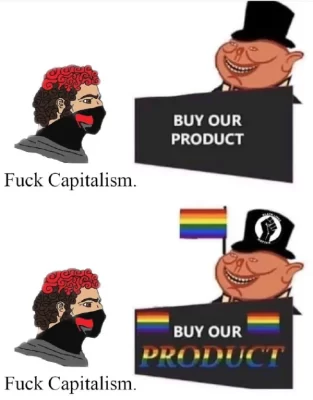
The political far right has made a great deal of hay in the last decade out of the phenomenon of ‘woke capitalism.’ Of course, they rarely bother explaining what the term ‘woke capitalism’ even means, beyond vague gesturing toward corporate DEI programs. To get a sense of things, we have to turn to the left.
On the left, we hear more interesting questions about the relationship between racial justice progressive activism and woke capitalism. The original Black Lives Matter movement sparked some of these issues. But we hear it far more in the wake of the pandemic era 2020 resurgence.
In short, does woke capitalism co-opt racial justice movements? Or do racial justice activists simply promote ideas that woke capitalism likes?
Let’s take a moment to examine the contenders.
One side says that the world of corporate diversity co-opts the genuinely radical demands of true racial justice activists. We find this view expressed well, for instance, in the book Elite Capture by Olúfẹ́mi O. Táíwò. I also profiled an especially egregious case in an earlier post that fits this model quite well.
The other side thinks that racial justice progressivism actually aligns with woke capitalism by pushing class to the margins and placing race in the driver’s seat. They think woke capitalism has no problem with racial equality, so long as the class system remains in place. We often find this view in the pages of Jacobin magazine or the books of Adolph Reed Jr. And, of course, I’m on record arguing that an ‘anti-racist capitalism’ is at least theoretically possible.
Mixed Truths about Woke Capitalism
In a recent issue of Lux Magazine, Gaby Del Valle takes up this debate. She presents it in the context of a review of Jennifer C. Pan’s book Selling Social Justice. And she firmly takes the side of the ‘co-opting’ view against Pan’s ‘alignment’ view.
What should we make of it?
In one sense, both sides are right. But in another sense, neither side is right.
What Del Valle and the ‘co-opt’ side gets right is that many racial justice activists lay out radical demands that woke capitalism can’t endorse. We’re not going to see a wave of woke capital coming out in favor of shifting most or all police funding to social services, for instance. Woke capitalists don’t like radically democratic mutual aid. Nor are they excited about demands by anarchists or Mariame Kaba to replace the criminal justice system with local, voluntary systems of accountability.
And so, Del Valle is correct to say activist movements get co-opted, insofar as woke capitalists nudge movements away from those kinds of demands.
No True Scotsman
But that’s not very far.
Many racial justice activists – even those in a ‘black power’ or ‘black liberation’ tradition – aren’t making the kinds of demands that woke capitalism strictly opposes. In terms of short term political programs, the vast majority aren’t doing or saying anything that a more ‘enlightened’ capitalism couldn’t get behind.
To get her thesis, Del Valle has to trot out a ‘No true Scotsman‘ fallacy. If the only people you count as activists are the ones making the most radical demands, then of course it looks like woke capitalism is co-opting the movement. But, in reality, these movements are quite diverse, and there are plenty of people not making the most radical demands.
Certainly only a small percentage of people taking part in 2020 marches really wanted to abolish the police. And the politicians we elect who take on an ‘abolitionist’ label show little interest in actually doing so, either.
The other problem with the ‘co-opt’ side is that any implementation of these ideas in the actual world would likely have effects opposite to the intended ones. And woke capitalists likely know this. Cedric Johnson develops this thesis capably in his book After Black Lives Matter, which I discussed earlier. In the current political environment, ‘police abolition’ amounts to replacing good union jobs with at least the potential for public accountability with a bunch of low paid, inherently unaccountable private security thugs.
None of that creates problems for capital.
The Class Origins of Ultra-Progressivism
So, where does that leave us?
There’s some truth to both sides. Woke capitalism does appear to co-opt racial justice movements in specific cases. But most racial justice movements don’t really threaten capital, so there’s no need to co-opt them.
We could leave it at that. But I don’t think this discussion quite gets at the core issues. And in that sense, neither side of the debate gets it right.
The core, underlying issue here is the class origin of racial justice progressivism – its politics and its key players.
Much of the racial justice progressive scene comes from a class coalition of young activists, non-profit leaders, petty bourgeoisie, and the professional managerial class. In Iowa City, for instance, we see these movements, including ‘abolitionist’ movements, mostly among non-profits, activist groups, and small business types with very socially progressive views.
These class origins produce specific political problems and gaps. They’re the same problems and gaps we find in anarcho-liberal spaces, largely because there’s strong overlap between these communities.
What are those problems and gaps? In short, they tend to produce wildly unworkable ideas. This happens, in large part, because those ideas are disconnected from working class life.
‘Voluntary community safety’ genuinely could work within a specific subculture, like the activist scene. It could also work in select, very liberal and affluent communities. In a sense, it already does. But it wouldn’t work anywhere else. At least not as a total replacement for a system that involves some use of force.
A working class movement, with broad representation of working class people and with political development and education, could produce far better ideas.
