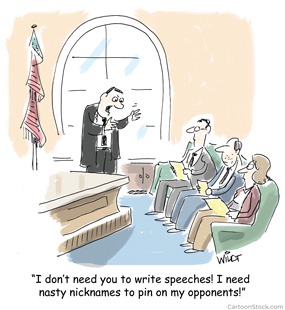
As a college student over 20 years ago, it was fashionable to identify as a person who voted ‘based on issues’ rather than based on party.
You probably know the idea. You didn’t just vote for a candidate because they ran as a Democrat, Republican, Libertarian, or Green. Rather, you looked carefully at their platform and voted for the person who ticked the right boxes.
Admittedly, we weren’t as clever as we thought. For leftists, the idea was to talk tough to Democrats. We said to them that we had certain issues we prioritized – health care, and so on – and we’d abandon the Democrats if they weren’t willing to fight for those issues. We announced our intention to vote for Ralph Nader – or an appropriate Nader equivalent – if Democrats failed to get with the program.
In practice, though, leftists rarely carried out the threat. Democrats repeatedly shunned universal health care. Most leftists continued voting for them anyway.
No doubt people at other points on the political map ran their own version of this. Centrists looked to candidate platforms to ward off ‘extremists.’ And right-wingers wanted to see the greatest hits of their own policy goals, lest they vote for some obscure right-wing third party. They didn’t carry out the threat, either, though they seemed to have more success at pushing their own views on party leaders.
Platform in 2026?
Much of this system has broken down by 2026.
It started with Obama and Trump. By the 2020 election, the GOP didn’t even bother writing a new platform. They threw themselves entirely to the whims of their strongman Trump, and they lamely re-endorsed their 2016 platform. And in Congressional and gubernatorial elections, it has become fashionable for candidates to say little or nothing about what they actually plan to do in office.
Let’s take a quick peek at our own Congressional and gubernatorial elections.
Our two candidates for House are Mariannette Miller-Meeks and Christina Bohannan. Miller-Meeks includes issues and accomplishments on her Congressional page. But she has nothing even resembling a platform on her campaign website. Bohannan’s campaign website is better. It includes a broad outline with a list of priorities. But it’s tough to read, and it’s interspersed with her own background and personal story. Neither candidate provides voters with an accessible window into what they hope to get done in office.
And in our gubernatorial race, Rob Sand’s campaign website mostly contains ‘bipartisan’ posturing and anti-culture war rhetoric. He does have a few priorities listed, along with some material more appropriate to a state auditor than to a governor. But he has no comprehensive platform or anything approaching one. Zach Lahn’s website is far better, containing fairly extensive information about what he hopes to do. Obviously those things are things I don’t support.
Why?
So, that’s the problem. But why do our candidates increasingly leave their platform off their website? Why aren’t they telling how they plan to use the office they want us to elect them to?
To some extent, they seem to think voters don’t care. We live in a hyper-partisan era where too many people see politics as team sports. Some join the D Team and root for Democrats, while others join the R Team and root for Republicans. They don’t seem to really care what the candidates do with power, other than use it to suppress or ‘own’ the people on the other team.
Candidates thereby use campaign websites for different reasons. They use it to solicit donations and volunteers.
And then, of course, there’s the fear of making a mistake.
If writing a platform doesn’t bring any real benefits in 2026, it does still come with risks. The Republican Party has turned itself into a party centered on the personality of Donald Trump. Their candidates hop over one another to more closely align to Trump himself. The few platforms we see from Republicans recycle Trumpist sounding words and phrases, e.g., MAGA/MAHA, America First/Iowa First.
That’s what we see from Lahn.
Democratic candidates avoid anything that sounds controversial or might antagonize anyone. They avoid commenting on substantive issues for fear either of irking one of their various internal factions (e.g., moderates, progressives, etc.) or inadvertently using language the far right can use in an ad. Nevermind the fact that these ads aren’t even effective. The very thought of an ad appearing seems to drive Democrats into fits.
What Should We Do About It?
In response, I find myself with a similar set of questions and options as I did about 20 years ago. It’s just that the underlying situation has flipped.
I vote for candidates based on what they’re going to do in office. I do my best to figure out what they’ll do with the power they’re asking me to give them.
However, if they refuse to tell me what they’re going to do with their office, I don’t vote for them. Period. There’s no excuse to vote for a person who has no plan for how to use power. Politics is about marshaling the powers of office to get things done. It’s not team sports.
Each voter should set a similar standard. It’s the job of a politician to earn our vote, not our job to vote for a candidate because they’re on the correct team. Good vibes, team sports, and alignment to our particular culture or sub-culture isn’t a good standard for when to vote for someone.
If a candidate wants my vote, they need to tell me how they plan to use power.

Leave a Reply