Welcome to a special Thanksgiving edition of the reading list! Here’s what I’m reading around the holidays.
How about you?
Daniel Bessner – Imperialist Realism
This is a collection of essays from the late 2010s and early 2020s. It covers the theme of what’s possible in politics in the U.S. Empire in our current age.
Bessner’s most compelling and original contributions come in the first section. He labels it ‘theory,’ and he points out that certain forces heavily structure what’s possible in the contemporary United States. In particular, he cites our common attitude of cynicism about the U.S. and its role in the world, our odd sense of mission that accompanies it (citing Call of Duty, of all things), and our sense of tragic guilt about the U.S.’s ultimately negative role in the world.
There’s a lot to dig into here, which I won’t be doing in this very short review. But I’ll at least say that I think the direction Bessner wants to go with this – to advocate a humbler, more cautious and restrained foreign policy – is the correct one. As for the project of conceptualizing ‘imperialist realism,’ I think that goes about as well as it could. We live in an era where it’s difficult to draw any cultural generalizations at all. Insofar as one can do it, however, Bessner does it plausibly.
The other essays are hit or miss, moving back and forth from insightful to dated to repetitive. In particular, the portraits hit all these notes, with a steady, common theme of politicians and officials who challenge U.S. Empire at the surface but ultimately accept its premises. And the politics essays provide a more detailed justification of some of the earlier conclusions. Particularly the advocacy against U.S. interventionism.
As far as essay collections go, this one is worthwhile. Bessner brings a lot to the table.
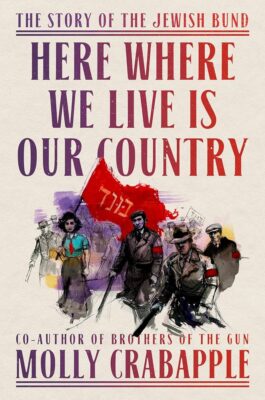
Molly Crabapple – Here Where We Live Is Our Country
Crabapple writes this well researched and reported history of the Jewish Labor Bund at a timely juncture. It comes when many are using the memory of pogroms and the Holocaust to justify the actions of the modern nation of Israel in Gaza and other places. In Crabapple’s history, the Bund counters the Zionist project with efforts to build solidarity and community in the places where their families are from.
The history runs the Jewish experience in eastern Europe in the 19th (and, briefly, even 18th) century all the way through the destruction of the Bund during and after the Holocaust.
Crabapple weaves the story with the history of her own family’s migration from eastern Europe to New York.
From it, I took away a couple of lessons. One, there’s a deep tension at the heart of the Bund between its uplifting message of hope for international and inter-religious solidarity with the disastrous practical results. It’s hard to know how to handle this tension except to acknowledge it and also the struggle for solidarity that the Bund never abandoned.
And second, the Bund offers many lessons in understanding our world today. It laid out a very basic critique of Zionism as enmeshed with antisemitism that still applies today – the two movements are, at a minimum, co-dependent. It’s also a more than century long tale of how people fight through oppression and maintain hope.
Robert Harris – Cicero Trilogy (Imperium, Conspirata, Dictator)
Imperium kicks off Harris’s Cicero Trilogy – a fictionalization of the life of Roman Senator Cicero. And this one covers Cicero’s early career – from his beginnings to his consulship.
Along the way, we get Cicero’s famous prosecution of Governor Verres, his early alliance with Pompey, and his education in philosophy and rhetoric. It’s all told through the perspective of Tiro, Cicero’s loyal secretary and the inventor of a famous method of shorthand to record Cicero’s speeches. The choice of Tiro as storyteller is a good one.
In Conspirata, Harris takes on Cicero’s two major battles – the condemnation of Catiline and Cicero’s own banishment from Rome. This is a particularly exciting phase of Cicero’s life and Harris captures it well.
Dictator finishes the story by focusing on the rise and assassination of Julius Caesar, followed by Cicero’s final grand foray into politics. This last round ends, of course, with Cicero’s execution. In terms of pacing and story, this is arguably the best of the three books.
Readers interested in the basic history should give it a go. The books, however, focus less on history (or philosophy) than on turning the story into a modern-style novel.
Hugh Howey – Shift
This is the second book of the Silo trilogy. It’s messier than the first, which is notable, because the first was messy enough. But this tells the back story of two key characters from the series – the Congressman Donald Keane, and the lonely resident of Silo 17, Solo.
Along the way, we find out much of the backstory of the silos – why they’re there, who made them, and what they were responding to. Without giving too much away, I’ll say that it involves nanos and cryogenic freezing.
I’m excited to read the third, and concluding, book. But, yeah. This story could’ve used an editor. I’d still recommend beginning with the TV show.
Rebecca Novack – Murder Bimbo
My book club took up this title for its October meeting, delivering it up under the theme of ‘books with bad titles.’
And while this one does, indeed, have a bad title, it’s a great book. It’s a fictional telling of the murder of a right-wing politician by a sex worker nicknamed ‘Murder Bimbo.’ And she tells the story three times for different audiences – once for a podcaster, once for an ex-girlfriend, and once for the (allegedly) ‘real’ version.
It provided our book club with lots of material for discussion. We hit everything from the nature of sex work to lesbian relationships and typology to the way we tell and re-tell stories.
In nearly a year and a half of meeting, I think this might have been the best book we’ve read.

Leave a Reply