Alienation, autonomy, and ideology

Category: Class (Page 23 of 25)

Polyamory and Neoliberalism

polyamory
Source: Robert Ashworth (https://www.flickr.com/photos/theslowlane/6000734775)

I’ll begin from this insight: certain kinds of personal relationships seem to ‘fit’ better with certain economic forms. That’s one (possible) implication of the ‘base and superstructure’ thesis, after all. But that’s just a starting point.

I think of this in roughly the same way Marx did, so long as we interpret Marx in a way that avoids any kind of hardcore historical determinism or teleology. The relationship between economic relations and personal relations isn’t one way and deterministic. The notion of a causal feedback loop is better, though that, too, has its shortcomings.

Rather, it’s a dialectical relation. As David Harvey points out in his Companion to Marx’s Capital, we’re talking here about a highly fluid and transformative relation. One that’s always in motion. The base and superstructure co-evolve, as it were. The base perhaps sets a basic tone, or a set of limitations, and/or an ‘easier’ path. But it’s much more open-ended than any deterministic relation or feedback loop allows.

And so, let’s start with some basic questions. What kinds of relationships best fit our current situation in the United States, which we might describe as ‘neoliberal capitalism’ or ‘financialized capitalism’? How do those relationships differ from those that fit the Keynesian consensus? Or the even earlier stages of industrial capitalism?

I’m writing here about polyamory in light of this background.
Continue reading

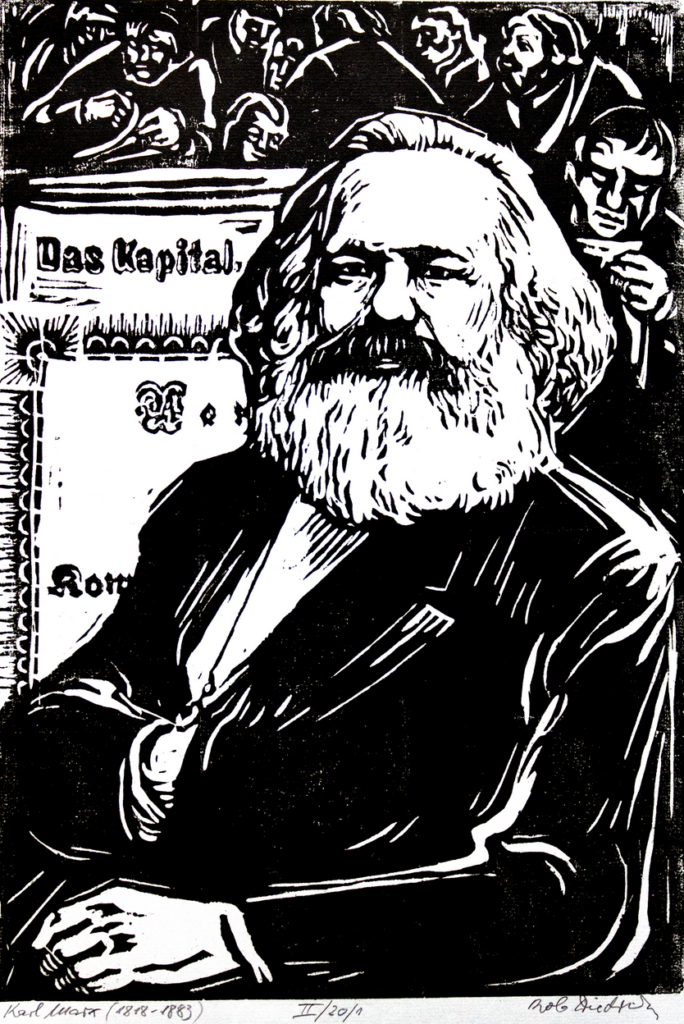
5 Tips for Reading Marx’s Capital

Capital Marx

So you’ve bought Volume 1 of Marx’s Capital, or you’re thinking about buying it?

Good for you! It’s a fantastic book, and you should read it! Capital is worthwhile for its historical significance alone, both to politics in the last 150 years and to philosophical and intellectual developments. But it’s also a highly relevant book to our current times. Particularly in an era of neoliberal or financialized capitalism, where many of the conditions Marx wrote about resurface.

Personally, I would’ve liked a bit more guidance when I started reading. I fumbled around quite a bit, and it took me awhile to understand what Marx was doing in the text.

What I lacked, may you have!

Continue reading

The Invisibility of Intellectuals

Fifty-two years ago, Noam Chomsky published an article in the New York Review of Books on the responsibility of intellectuals. He rebuked intellectuals for the way they supported and justified the Vietnam War. And that they did so despite having the social privilege and influence to push American power in different directions.

With respect to the responsibility of intellectuals, today we live in a different world. I’ll argue that it’s invisibility that defines the intellectual now. Whether intellectuals defend and justify American atrocities is, in a way, beside the point. Because American power no longer relies on intellectuals in the ways it once did.

From there, I’ll sketch some thoughts about how to address this new world.

Continue reading

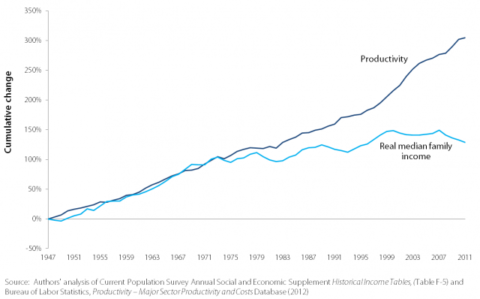
About That Productivity and Income Graphic

Check out that productivity and income graphic above. Maybe you’ve all seen it before? I think I’ve seen it a billion times and shared it a million times.

At some intuitive level, we know what it means. Capitalism has screwed American workers for at least 4 decades.

But a lot of people miss the point of the graphic. Let’s talk about what it means and does not mean.

Continue reading

Is Trumpism a Fascist Movement?

Trump Fascist

Source: Alisdare Hickson (https://www.flickr.com/photos/alisdare/42730197674)

As I said in my previous post, I’ve been sitting for awhile on the question of whether Trumpism is a fascist movement. But to answer this question, I needed to first sketch out what fascism is. A lot of people use ‘fascist’ to mean something like ‘very bad.’ Even historians and social scientists use the word without thinking about the economic and political contexts in which fascism grows.

So I offered five historical conditions where fascism grows. And a starting point for defining it. That starting point was: Fascism is the emergency management mode of capitalism. It arises during times of serious crises and left-wing threats in order to save capitalism from itself.

Here we are, then. Is Trumpism a fascist movement?

Continue reading

« Older posts Newer posts »