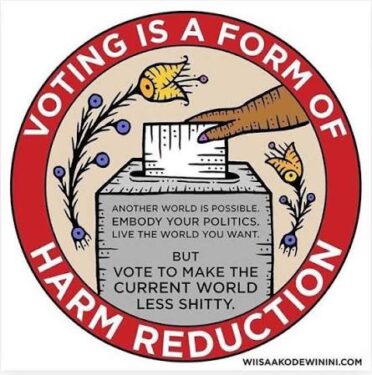
I’ve taken several cracks at common arguments progressives and leftists use to justify ‘voting blue no matter who.’ This includes, of course, the harm reduction argument. I even threw in an argument against a mutated form of the harm reduction argument, i.e., the odious ‘privilege argument.’
I’m satisfied with my previous work on the topic. The posts I linked above adequately address the intellectual basis for harm reduction voting arguments. But they dont quite hit what’s so irksome about these arguments. They don’t hit why ‘harm reduction voting’ so annoying to me and psychologically satisfying to many progressives.
So, that’s the topic I’ll hit today. I’ll cover what’s deeply out of order about the harm reduction argument for voting Democratic.
And it’s this: the argument is grounded in a fatally flawed analogy.
Harm Reduction Voting Doesn’t Reduce Harm
As many readers know, the notion of harm reduction comes from the public health community. In that community, harm reduction is about providing people with proactive steps they can take to reduce the negative consequences of actions such as drug use or sex with multiple partners.
In taking a harm reduction approach, public health practitioners accept that people will engage in actions that put themselves and others at risk. But rather than preaching ‘abstinence’ at them, which almost always fails, they provide them with tools (e.g., clean needles, condoms or dental dams, and so on) to reduce risk.
It’s not difficult to see how we might use an analogy to apply this to voting. In my previous post on the topic, I even distinguished two ways to do it – relative harm reduction by voting Democratic, which is just a restatement of the ‘lesser evil’ argument, and absolute harm reduction by voting Democratic, which is a version I generally endorse, but which sets a standard most Democrats don’t actually meet.
But the analogy fails. And here’s why.
Individual acts of harm reduction in public health, such as passing out condoms or doing needle exchanges, meaningfully reduce harm in most individual acts of harm reduction. Giving someone a condom or dental dam meaningfully reduces the chances they’ll pass or contract an STI. Giving someone a clean needle meaningfully reduces risk of infection.
But voting Democratic, as an individual, does not meaningfully reduce harm.
Why Voting Democratic Doesn’t Reduce Harm
Let’s talk about why.
The only way an individual’s vote actually reduces harm is if it’s the deciding vote in an election, i.e., if it actually changes the results from a tie or Republican win to a Democratic win. Otherwise, it does nothing.
But the chances of this happening in any given election are ridiculously, stupidly tiny. In 99.99999% of cases, voting doesn’t reduce harm. By contrast, needle exchanges and sexual protection make real, measurable impacts. Any time you do it, there’s a reasonable chance it’ll make a difference.
None of this is to say Democratic candidates aren’t better than Republicans. They usually are. Nor is this even to say you shouldn’t vote Democratic. That’s not the claim here.
Rather, the point is that ‘harm reduction’ isn’t a serious reason to vote Democratic. It’s nothing more than a bad analogy – a way of justifying a decision by intellectualizing it and tying it to a public health term it’s got nothing to do with.
If you want to practice harm reduction, do a needle exchange. If you want to give a reason for voting Democratic, bark up a different tree.

Leave a Reply