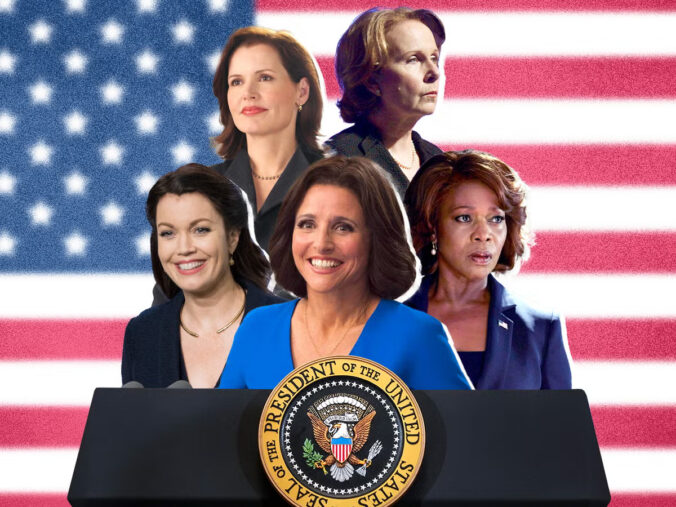
Politicos from all over the Democratic Party have been declaring for the last year that a woman can’t win the presidency. Even Michelle Obama made the claim!
What’s up with that?
Let me start by saying the claim is obvious baloney. But once we’ve established the utter foolishness of the claim, we have to figure out what to do. Why do people keep making claims this like?
I’m going to provide an error theory to explain it. We’ll begin from the point that the claim centers on certain professional class liberal anxieties.
And it says more about them than it says about the world.
A Woman Could Obviously Win the Presidency
There’s no point in beating around the bush. A woman could win the presidency. This is obvious. It’s so obvious that its denial calls for an explanation. But at the risk of tedium, let’s point out why it’s obvious.
Professional class liberals base the claim largely on the results of the two elections in which women ran and lost – 2016 and 2024. But these elections show the exact opposite.
Let’s take a closer look at 2016 and 2024. In 2016, Democrats nominated a massively unpopular woman. And she won nearly 3 million more votes than her male opponent. Yes, she lost the race. But the loss happened due to a fluke electoral college victory by her opponent, Donald Trump. Without these lucky breaks, Hillary Clinton would’ve been the first woman president.
In 2024, the Democratic Party handed the nomination to a woman at the last minute. This put her in a nearly impossible situation, with the Democratic Party deeply unpopular. A massive wave of post-pandemic inflation had already led to the demise of incumbent parties around the world. Despite these obstacles, Kamala Harris lost one of the closest elections in U.S. history. With a bit of luck – or just some meaningful effort to distinguish herself from Joe Biden – Harris would’ve been the first woman president.
The Point
Let’s state the point clearly. In the entire history of the country, only two women have been nominated for the presidency on a major party ticket. By comparison, since 1804, 110 men have been nominated. The two women won nominations in tough times.
Clinton lost for many reasons, but her gender wasn’t a key reason. She was an unpopular defender of the establishment in an anti-establishment election cycle. Trump effectively drew on the anti-establishment currents, while Clinton continued defending the status quo. And Harris was given the nomination after her party colluded to cover up Joe Biden’s infirmities. They got called out for it after a disastrous presidential debate. If anything, her gender might have counted as a mild benefit. After all, it’s one of the few things that actually distinguished her from the deeply unpopular Biden.
And these are the cases people cite as evidence a woman can’t win? Not only could a woman win, but one very well might win in 2028 just as easily as a man. Indeed, were it not for the quirky electoral college system, it would’ve happened in 2016. And if we want to really pile it on, it would’ve happened in 2008 with just a few people voting differently in the Democratic primaries.
There’s just no case for the claim that a woman can’t win. It calls for an error theory. Why do so many professional class liberals keep asserting it?
Identity on the Brain
At the surface, this looks like yet more bedwetting of the sort we see among Democratic consultants and their professional class liberal base. They wrap themselves up so deeply in electoral politics that any loss sends them into an emotional tailspin. Without even the faintest notion of working class political action, they have no other option. And in that intellectual swamp, any loss by a woman becomes irrefutable evidence that a woman can’t win.
Digging beneath the surface, I see certain philosophical assumptions that professional class liberals share with the far right. Both hold the view that identity is the most important political issue, even at times the view that all politics are identity politics. And they transfer this opinion onto voters and their motives. At its most extreme, this slides into ‘identitarianism,’ i.e., the reduction of politics to identity.
The problem is that this is all utter nonsense. Both professional class liberals and the far right miss wildly. Most people don’t place identity in such a central role in their politics. Few voters cast ballots either on the basis of the identity of the candidate or on the shared concerns of identity groups. In fact, voters care most deeply about having a good job, accessing health care, and being able to afford the things they need. Most people just want to live a good life.
After Barack Obama’s win in 2008, it should be abundantly clear that a candidate of any gender or race could craft a winning message. And the person could very well be a member of either party. Both professional class liberals and the far right miss the obvious point that our first woman president very well might be a Republican.
Final Thoughts
This post began with a question that has an obvious answer. Yes, a woman could win. In fact, I’d wager it will happen more than once in my lifetime.
But we ended with a more interesting story about why people keep asking the question.
We live in a difficult era of neoliberal domination of our economy. Among other problems, it robs us of our political imagination. We see capitalism as the only game in town, and we see the generation of capital as the only way to make our lives better. For those of us under the age of 40, we’ve never seen anything else.
Most distressingly of all, this leaves us with little room for political struggle or even meaningful disagreement. How do we play the game of politics in this era?
Into this vacuum flooded the notion that we might organize our politics around identity. If class politics are out – if we can no longer struggle together for material benefits and power, and if our use of the internet and social media leaves us unable to even know our neighbors – perhaps we can put people together by race or gender and struggle symbolically.
But it never quite works. It’s not the same. Identity just doesn’t sit at the heart of our real struggles, and it will never play that role for us. Its politics never land.
And in cases like the question at the headline of this post, it leads us astray. It leads us to ask and say the silliest things.
