It’s exciting to begin the new year with a new reading list! And, of course, there’s always more to read. Here’s how I’m starting my 2026.
Let me know what you’re reading these days.
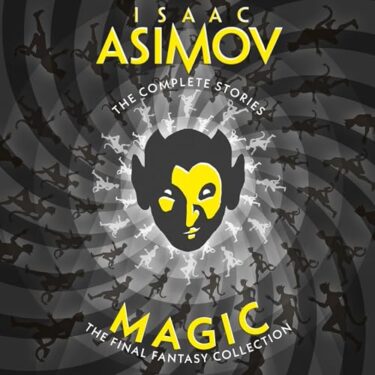
Isaac Asimov – Magic
What better way to start a new year’s reading list than with an Asimov story collection?
This set collects many of Asimov’s fantasy stories together with a number of essays on a wide range of topics.
The fantasy stories revolve around Azazel, an extraterrestrial being with apparently magical powers to change people’s lives. But most of those changes have ironic, and usually hilarious, implications. The stories are generic, but they’re entertaining.
Many of the essays cover the definitions and boundaries of fantasy as a genre. Others cover everything from science to religion to Asimov’s life and his thoughts on thinking. On the whole, his essays hit the basic themes of liberal egalitarianism on which he built his intellectual foundations. And most appear to have been written in the 1980s, when such views were in short supply.
Kaliane Bradley – The Ministry of Time
This recent sci-fi book turned out to be a quirky combination of a time travel story and a rom-com. The romance part happens between the main character and a 19th century explorer brought into the future.
On the whole, I found the plot really interesting. The characters struggle through issues of war and environmental devastation, as well as the adjustment to different eras of time. The author did a lot of compelling work to bring a wide range of early modern era characters into the present.
We also get compelling villains in the form of 23rd century time travelers and one very Killmonger inspired character suffering from resentment to racism.
That said, the plot felt very jammed into the last 50-100 pages of the book and a bit under-developed. Most of the pages are taken by a slowly building romance story between the main character and a time traveler. It’s not a bad story, exactly, but it’s less compelling than the main events. To me, it felt like a side plot elevated into the main part of the story.
For that reason, I’d call this a decent book, but I think it could’ve been a lot better.
Casey Burgat – We Hold These “Truths”
The basic idea behind this book is to help guide the way toward an improved American civics by pointing out commonly held myths, encouraging people to stay open minded and talk to their neighbors, and showing how myths have made people cynical and mistrusting.
It’s a book teeming with optimism. And the mythbusting part mostly goes well.
Different authors write short essays that point out many different misconceptions. What kind of misconceptions? Here are a few: that the Founding Fathers mapped everything out about our politics, that we vote for the issues rather than the party, that the president is all-powerful, that term limits will fix our political problems, and so on. The psychological research showing that voters change their stance on issues based on party alignment is especially interesting.
While that’s all well and good, and a valuable service, the authors accept a few myths of their own. For one, in a chapter on busting the myth that Congress doesn’t do anything, the author (a Congressman) includes a sample schedule to show that he ‘works all the time.’ Predictably enough, the schedule is an endless series of meetings. Does that count as work or ‘talking about work’? It’s a question many of us in the white collar world ask.
In a more serious error, the authors routinely assume that open-mindedness and productive politics go with political moderation. In other words, they routinely advocate voting for moderates to make politics function more effectively. But I think that’s just wildly misguided. Many of the most hardcore, rigid partisans I encounter are moderates. This is especially accurate on the Democratic side.
William B. Irvine – A Guide to the Good Life
Irvine transformed his life by adopting Stoicism in middle age. He carefully documents his Stoicism as a way of life, and he talks about its impact on him.
But does this help readers? The first thing to say is that Irvine’s Stoicism is idiosyncratic. He situates virtue as an intrinsic value, but he focuses more on tranquility. In that respect, his Stoicism comes off as more of a hybrid between Stoicism and Epicureanism. And so, the Epicurean might draw as much value from this book as the Stoic.
And like many modern Stoics, he recommends setting aside Stoic metaphysics.
This leads Irvine to focus on adopting Stoic psychological techniques and values. He centers especially the practice of negative visualization. We can build up psychological resilience by moderating our desires and imagining what it would be like to lose what we have. It’s through this that we can learn to be satisfied with what’s easily achievable.
Irvine also emphasizes the distinction between what’s in our control and what isn’t. He further emphasizes that we should focus our goals inward on what we can achieve rather than focusing on external events. And he uses this to gently modify modern psychological theory, which tends to emphasize the expression of emotion.
Finally, Irvine offers a range of life advice on how to practice Stoicism and achieve tranquility. He suggests ways to deal with insults and handle grief, among other topics. I think these are valuable tools, and readers can adopt many of them. With that said, it’s again worth noting that Irvine’s Stoicism is idiosyncratic. If there’s a key lesson here, it’s that we can usefully adopt and combine Stoicism with other traditions in a meaningful way.
Michelle Obama – Becoming
Michelle Obama has enough of interest in her life experience that I’m surprised I hadn’t already read her autobiography. But, indeed, I hadn’t.
Most people know her as the spouse of a president, and those years end up taking up about half the book. But, to be honest, I found the chapters on her childhood and early professional years – the times before she met Barack – by far the most interesting. In those years, we find Obama struggling through a working class background and inadequate school to stand out.
She finds herself at Princeton and then at law school. There’s a lot to learn in that journey, both about individual persistence and about the disconnect between the fortunes of the individual and the broader class and neighborhood. And the lessons continue as she exits law school, enters corporate law, and leaves corporate law to search for more meaningful work.
By contrast, I didn’t get much out of the book after Barack becomes a politician. In many ways, the second half is a standard political biography, though focused on the role of the First Lady rather than the politician. We see much less of Michelle, and we see her become almost a side character in her own story. She does acknowledge this a bit near the end, though not in an especially satisfactory way.
