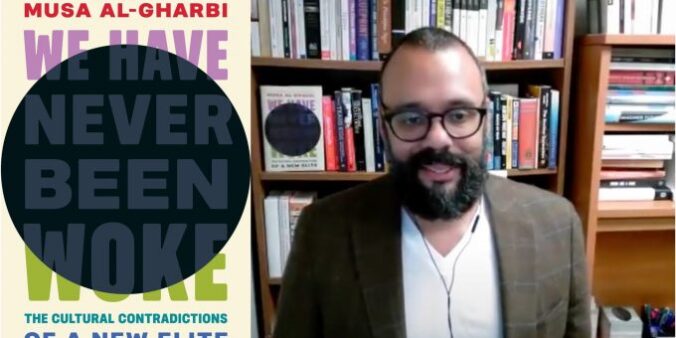
This country feels different than it did just a few years ago. We’ve moved past the ‘Great Awokening’ and into a backlash phase. Many of us – especially liberals, progressives, and/or college graduates – seek answers. How did it happen? Musa al-Gharbi offers answers in his book We Have Never Been Woke: The Cultural Contradictions of a New Elite.
But they might not be the answers folks seek.
Let’s take a closer look at We Have Never Been Woke and find out.
‘Woke’ and Symbolic Capitalists
Here’s the argument in a nutshell: Symbolic capitalists use woke ideology as a special type of capital. They use it in order to gain status and compete with one another rather than to actually achieve social justice.
But al-Gharbi needs to do a lot of background work for this to make sense. First of all, he needs to unpack the terms ‘woke’ and ‘symbolic capitalists.’
On the former, he doesn’t actually define ‘woke.’ He’s using the term sociologically to pick out the systems underneath the common use of the word. On this way of thinking, ‘woke’ is a kind of concern for social justice that focuses on culture, symbols, and language rather than on material change. The term served largely as a replacement for the discredited term ‘politically correct.’
That leaves us with ‘symbolic capitalists.’ These are highly educated people who work in the white-collar world, particularly in professions like journalism, academia, law, and technology. Al-Gharbi uses the term as a synonym for the ‘professional managerial class.’ But he sees them less as a class than as a class in formation. They have interests in common, but they’re not necessarily putting it together as a united front.
One thing that unites most symbolic capitalists, though, is that they’re the people who promote woke ideology. Paradoxically, though, they have little in common with the marginalized people woke ideology purports to serve.
That disconnect forms much of the basis for the al-Gharbi’s analysis in We Have Never Been Woke.
Elites in Denial
Al-Gharbi provides a pile of empirical evidence showing that symbolic capitalists are elites. But they deny their status. How do they do this? They ground their politics in concern for the marginalized, i.e., in ‘woke.’ However, in the actual world, they use marginalized people to clean their houses, deliver their goods, prepare their food, and so on.
This creates tensions.
Furthermore, symbolic capitalists hold more or less a monopoly on woke ideology. Actual marginalized people don’t buy into it. Even worse, symbolic capitalists push narrow symbolism and language policing in a way that sparks backlash against actually marginalized people. And so, a bunch of jargon marginalized people don’t even use comes back to bite them.
We Have Never Been Woke provides many examples of this in action. Consider the term ‘Latinx.’ Most people the term picks out hate it. But a symbolic capitalist elite – mostly white, but also including highly educated non-whites – keep the term around as a status symbol. Al-Gharbi argues they do so in order to shore up their elite status.
The Great Awokening
From here, al-Gharbi contextualizes the ‘Great Awokening’ of 2010-2021. He argues it’s really the fourth Awokening. Each resulted from an economic crunch that hit symbolic capitalists.
He reads the 1930s student movement as the first, produced by a jobs crunch among elite liberals flooding the symbolic professions. The New Deal solved it. Restrictions on college deferments produced the 1960s student movement – the second awokening. And Richard Nixon solved it by abolishing the draft. Austerity and increased jobs competition from high skilled immigrants produced a smaller third awokening in the late 1980s and early 90s, which the rise of bullshit jobs and new immigration restrictions solved.
So, that leaves us with 2010-2021. The U.S. severely overproduced college graduates beginning in the early 2000s, and the economy crashed in 2008. The caused a rise in elite competition, which created the need for new ‘woke’ status symbols. And then the rebound of jobs in the early 2020s settled the crisis, though this is already starting to fray.
In each case, economic problems among white liberals produced a rise in ‘woke.’ And in each case, ‘woke’ declined as elite white liberals solved those problems. None of these awokenings, al-Gharbi argues, came from marginalized people. Nor did they benefit marginalized people.
The end result of this is that people aren’t any better off at the end of awokenings than they were at the beginning. Society remains every bit as unequal. And few genuinely benefit, aside from white liberals, elite minorities, and DEI bureaucrats.
Politics and We Have Never Been Woke
At heart, al-Gharbi sees symbolic capitalists as class warriors using social justice as a tool. They sincerely hold their progressive views. But they also use those views to achieve status, even monetary benefit.
They certainly don’t base their ideology on a careful reading of theory. As al-Gharbi convincingly documents, many of the ‘woke’ don’t really understand the jargon they spout.
I have to add that I’ve also found this to be the case. In discussing ideas like standpoint epistemology or intersectionality with symbolic capitalists, I often find they have no idea how these ideas work. They buy into oversimplified and wildly inaccurate readings.
This shades into ‘totemic capital,’ which al-Gharbi defines as a kind of epistemic and moral authority granted on the basis of identity. He carefully documents cases of symbolic capitalists either falsely claiming to be a member of an identity group awarded such capital (e.g., Elizabeth Warren’s claim to be Native American), or creating new identity categories to award this capital (e.g., ‘neurodivergent’).
While al-Gharbi is careful to distance himself from value judgments, I thought this point needed greater nuance and care. These identity labels are complicated, and there’s a lot more going on than what symbolic capitalists are doing.
Symbolic Capitalists and Movements of the Marginalized
This leads me to one of al-Gharbi’s missteps. In each of these eras, genuine movements of marginalized people existed. Workers built unions in the 30s. The civil rights movement fought the elite, especially in the 60s.
Al-Gharbi only partially answers questions about how ‘woke’ relates to this.
But he rightly points out that these movements used broader language and built broader coalitions. And he points out how symbolic capitalists generated problems here. They tend to take leadership roles and steer orgs toward less useful methods. This includes non-white symbolic capitalists, who are quite good at using programs for the truly marginalized to benefit themselves.
Some Fuzziness
In We Have Never Been Woke, al-Gharbi begins with a puzzling notion – the repeated emergence of ‘woke’ views in particular situations – and gives it a plausible sociological explanation. That’s a valuable service.
I think he does a decent job picking out a real group of people with the term ‘symbolic capitalists.’ And he tells us what they do and why it’s ineffective.
That said, I find a few problems lurking. For one, I think he runs together ‘symbolic capitalists’ and ‘elites’ too hastily. His pile of empirical evidence focuses on the latter. And he uses various proxies, e.g., high income people and college educated people, to draw inferences about the former.
As a rough proxy, that’s OK. And it’s about the closest the literature actually comes to the right group. But as an argument for the claim that symbolic capitalists are elites, it’s question begging. I think the best we can do is to say that there’s overlap, and that many symbolic capitalists are probably elites.
As someone who wants to hold out the possibility of putting together lower wage white collar workers into a broader labor coalition, however, al-Gharbi’s route has obvious drawbacks. It fails to draw the right distinction – i.e., the one between workers and managers.
Finally, I’d be remiss not to point out that al-Gharbi’s reading of Marx is quirky, at best. It’s not a reading I see in the text. But we’ll save that for another time.
