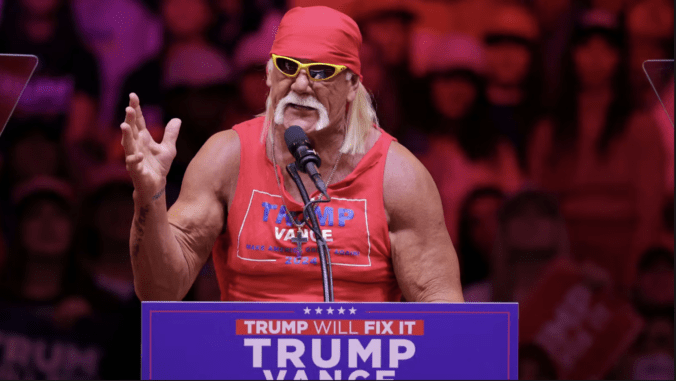
We have no shortage of comparisons and metaphors for the Trump presidency! Let’s see how professional wrestling and kayfabe fit into that picture.
Many of these metaphors stem from the Great Fascism Debate, which I joined for some time before swearing it off. Among other problems, the “Trump as Hitler” and “Trump as Mussolini” move is lazy. Even worse, it commits the sin of lack of imagination.
But I’ve flirted with several comparisons myself. Entering the 2016 race as a media mogul using right-wing populism and a kayfabe personality to climb to the top, Trump looked remarkably similar to Italian Prime Minister Silvio Berlusconi.
More interestingly, I compared Trump to trash TV character Al Bundy from Married with Children.
How’d that go? Bundy was a roughly middle class guy in suburban Chicago, so he’s not like Trump in terms of job or income. Rather, Bundy personified the Trump voter. He aired white male grievances at a variety of targets – a feminist neighbor, a woman boss, a Latina TV anchor, and so on.
However, these metaphors have all become tired. With that in mind, let’s return to that earlier word ‘kayfabe.’ Maybe it can offer us new clues.
The Kayfabe Presidency
When I opened a recent issue of Current Affairs and saw ‘The Kayfabe Presidency‘ by Jason Myles, admittedly I rolled my eyes. The notion that U.S. politics increasingly looks like scripted professional wrestling is hardly new. And surely most of us know by now that Trump was deeply involved with Vince McMahon’s WWE (née WWF) for many years.
So, what new insights could Myles draw from this?
Several, it turns out. He does a particularly nice job mapping out how wrestling kayfabe structures Trump’s media brand and also the ways his base listens to him and responds. Trump stage manages his moves and his politics to produce the right responses at the right time.
And perhaps most key to this, Trump’s Democratic opponents fail to get it for a specific reason. As the Democrats marched into the 21st century, they chased after a professional class political base. This base doesn’t understand kayfabe at all. We’re talking about highly educated professionals who wouldn’t touch professional wrestling. And the few who do find it too repellent to engage with.
That’s a problem.
‘Neokayfabe’
Myles performs a valuable service by introducing readers to the term ‘neokeyfabe.’
A couple of decades ago, WWE – and professional wrestling as a whole – fully embraced the notion that wrestling is scripted and has predetermined outcomes.
Of course, at some level, the world always knew this. Even as a kid, I understood at a deep level that pro wrestlers didn’t really fight one another. But we were all quite good at pretending. And sometimes we pretended so well that we called it ‘real.’
But that illusion burst for wrestling fans over the course of the 1990s. Why? WWE stopped telling us it was real. Instead it told us that wrestling was ‘fake.’ But it still allowed us a space to choose our own reality – to pretend that it’s real whenever we wanted it to be real.
That’s neokayfabe.
It’s also Trumpism, or so Myles claims.
Trump invites his voters to make real anything Trump says or does. This includes even executive orders that no one implements or walls that no one builds. Symmetrically, Trump voters can block out the reality of anything Trump does that they don’t like.
Social Democracy as Response?
All this is quite disorienting to our politics. And Myles appeals to social democracy as a response. We can make concrete improvements to people’s material welfare as a way to fight the kayfabe presidency and neokayfabe.
I’m obviously sympathetic to all this. Why? Well, I also advocate for social democracy as the most plausible short-term step along the path to socialism.
But the politics of kayfabe introduce new difficulties to our path to socialism via social democracy.
For one, anyone opposed to social democratic programs can, to a greater extent in 2026 than ever, simply pretend that the programs aren’t real or aren’t effective. Any effort to genuinely break through the fog must get the right level of attention. In kayfabe terms, programs like Medicare for All have to generate heat.
In addition, we have to work past the vast individualizing trends in our society. These trends split us into consumer markets, subcultures, and, in wrestling language, brands.
Finally, even our leftist politics embrace a form of kayfabe. In this form, we use leftist symbols or slogans – the hammer and sickle, the language of ‘mutual aid,’ and so on – to denote activity that’s not really political or radical. But what we need is the opposite. We need genuinely radical ideas that appeal to the uninitiated.
That’s a tough nut to crack in the kayfabe political era.
