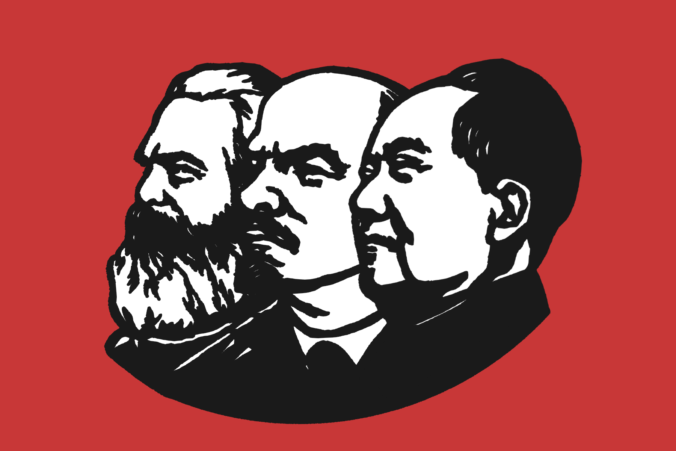
Lenin and Mao were titans of 20th century leftist theory and revolutionary practice. They led the two most famous Marxist revolutions in world history, and they applied Marxism to unique historical conditions.
Neither man had it easy. Both faced nearly impossible situations.
At a fundamental level, however, both made key theoretical mistakes from which we can learn. This short post highlights one central major problem with each man’s work.
Lenin: Centering the Revolution on Underdeveloped Countries
Lenin’s Bolsheviks endlessly debated whether it’s possible to run a successful socialist revolution in a country at an early stage of development. They focused on the border between feudalism and capitalism. And specifically…Russia in the early 20th century.
The Bolsheviks knew Russia wasn’t ‘ready.’ They knew they needed a revolution in Western Europe to kick things off. And Lenin and Trotsky even admitted that a failure in Western Europe would probably doom the Soviet Union.
They created plans to overcome the problem, with Trotsky’s ‘permanent revolution‘ – a continuous socialist state that would perform the historical role of the bourgeoisie and transition the Soviet Union through the capitalist stage and into socialism – the most developed and ambitious.
But, in practice, we know how it turned out. Not great.
The revolution in the West failed, and the Soviet Union was isolated. Stalin’s ‘socialism in one country’ was the disastrous result. It turned a once optimistic experiment in socialism into a bureaucratic, authoritarian mess.
Mao: Making Imperialism the ‘Principal Contradiction’
Mao faced a broadly similar situation to Lenin in some ways. China was also at an early stage of development with a population consisting mostly of peasants. But it was also a country under threat from an imperialist Japanese conqueror.
While the Soviets attempted to build the working class and industrialize, however, Mao pulled back and questioned this strategy. Instead he proposed that the conflict between bourgeoisie and proletariat wasn’t the ‘principal contradiction’ in China. Rather, he centered the conflict with imperialist Japan.
This was innovative and kicked off a wave of anti-colonial action.
But the result, particularly when applied elsewhere, has been the formation of ‘campist‘ politics and its ills. The excesses of identity politics also descend, intellectually, from Mao. These movements excuse third world authoritarians (and identitarians) who long ago lost any actual interest in socialism.
The height of absurdity comes in the defense of dictators such as Maduro in Venezuela, Putin in Russia, or al-Assad in Syria.
But it didn’t go all that well in Maoist China, either. After Mao, Chinese leaders adopted capitalism and established China as an imperial rival to the U.S., at least in Asia. It’s a competing imperialist power, not an anti-imperialist force.
Lessons
So, how can we summarize their mistakes? Lenin rushed a revolution in a country that wasn’t ready for one. And Mao de-centered the very conflict at the heart of a capitalist world.
These are critical mistakes, and these mistakes resulted in deaths and failed revolutionary states.
But the point here isn’t to dismiss the work of important leftist theorists.
Lenin and Mao are still two of the most important leftist theorists of the 20th century. The point isn’t to hold ourselves as better or more ‘enlightened’ than Lenin or Mao. The point isn’t even to dunk on ‘tankies’ or ‘campists’ who excuse every harm done in the name of socialism or anti-imperialism.
Rather, the point is to learn from our past and maintain a core of integrity. We have to pay attention to historical conditions, not rush things, and not substitute our own conflicts for the basic class conflict at the core of society.
We can’t ignore non-ideal situations. It’s not about doing nothing and waiting for the right moment to come along. There are even specific situations where, in our politics, race or imperialism will become more important, for a time, than class.
But we also can’t set aside our core theoretical notions in the pursuit of power.

Leave a Reply