It’s properly fall, and along with that, it’s time to talk about what I’ve been reading lately! As usual, it’s an eclectic mix.
Please enjoy. And please send along any recommendations.
Amy Littlefield – Killers of Roe
Littlefield, a reporter for The Nation, turns her abortion and reproductive rights reporting into a book length investigation of the end of nationwide abortion rights in the U.S. in the wake of the overturn of Roe v. Wade.
Along the way, she does a great job undermining the narrative that the overturn of Roe was, in fact, the key event in the timeline.
So, how does Littlefield go about this project? She traces backward in time from Roe to its many precursors. Mostly these are the obstacles that states and cities put in the way of abortion rights in preparation for the right wing victory in 2022. From Catholic anarchists to patriarchal misogynists, she approaches the ‘killers of Roe’ by trying to understand their behavior and motivations.
Littlefield repeatedly uses Agatha Christie’s Miss Marple character as a metaphor to understand the investigation. She uses it to point out that understanding requires interviewing all participants and getting at their motives. And while the Miss Marple metaphor becomes annoying well before the end of the book, it nicely presents Littlefield’s project.
But there’s still a question of Littlefield’s goal. If she wanted to explain the fall of abortion rights, interviewing a variety of anti-abortion soldiers isn’t the best way to do it. But her approach does make for an excellent way to understand why people oppose abortion rights as well as their methods for doing so. Getting at the underlying religious motivations and the legislative and public tools is useful for fighting back.
Mark Mazower – On Antisemitism
Mazower is a historian taking on the history of the idea of antisemitism. It’s a hot political term. But there’s little agreement on what antisemitism is, where it comes from, and what role it plays in the world.
Mazower acknowledges that anti-Jewish beliefs and actions have a centuries long history. But he traces the actual term ‘antisemitism’ to the era of 19th century European nationalism. As nationalism spread, people began to think of Judaism as not merely a religion, but also a ‘nation.’ In response, some focused their hate upon a racialized Judaism, which came to be known as antisemitism. Others constructed positive visions of Jewish nationhood.
With this framework laid down, Mazower includes chapters on 19th century Jewish emancipation and the Holocaust. These eras saw a classical antisemitism that was easy to identify and deadly. He then turns to the Cold War and the modern era. At this stage, people increasingly conflated antisemitism with criticism of the nation-state of Israel. Mazower investigates the flip and ultimately finds it lacking.
Throughout, he never loses sight of basic fairness. Even though it’s clear Mazower believes (rightly) that the term ‘antisemitism,’ in 2026, serves more often than not as an cover for Israeli atrocities in Gaza (and elsewhere), he tries as much as possible to take an understanding approach that takes concerns as seriously as possible.
So, what has gone wrong with the term ‘antisemitism’? Mazower points to two competing senses of the term. One sense presents antisemitism as an eternal, trans-historical force that will never be defeated. It can only be battled by supporting Israel unconditionally. The second sense puts antisemitism into context, fights it, and believes it can be overcome.
Mazower obviously prefers the second over the first. And he’s correct in doing so.
Massimo Pigliucci – How to Be a (Happy) Skeptic
Pigliucci is known primarily for writing books on Stoicism as a biologist turned philosopher. In this one, he moves over to Cicero, taken as a famous ancient philosopher and representative of the school of Academic Skepticism.
Pigliucci uses Cicero to develop a modern version of skepticism as a check on the excesses of life in the age of the internet and social media. And, for the most part, it works quite well. We get a sensible treatment of fundamental philosophical questions of epistemology, along with targeted treatment of what’s important in life, citizenship, fact checking, justice, friendship, aging, and death.
Along the way, Pigliucci takes specific Cicero texts as a guide and weaves the story with the story of Cicero’s life.
I found it far more engaging and interesting than the book on Socrates I reviewed last month.
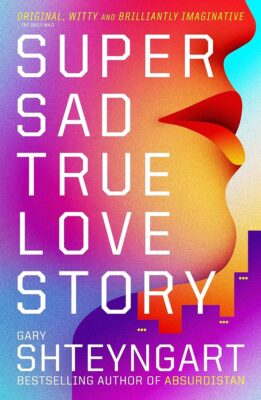
Gary Shteyngart – Super Sad True Love Story
This was another selection for my local book club. It’s an early 2010s novel that depicts a hyper-sexualized near future society where the U.S. is in decline. It could’ve taken place in the same fictional universe as Idiocracy.
Our two main characters – Lemmy and Eunice – meet in Italy and take up an unexpected romance in New York. Lenny is a 39 year old insecure young man working for a life extension company. And Eunice is a 23-24 year old vacuous Millennial stereotype who ends up as the more interesting and complex character of the two.
They navigate a world where the U.S. is in the process of being taken over by China and Norway. Not to mention invading Venezuela and falling apart at the seams.
It’s tough to get past the novel’s use of ethnic stereotyping, intentional misspellings, and extremely hyper-sexualized language and depictions. But if you can do that, it’s worth a read. I do think the novel says something about our current world and direction.
Edward Underhill – The In-Between Bookstore
I picked up this book because a book club was meeting to discuss it, and I thought about joining.
It’s the story of a trans man who grew up in small town Illinois before moving to New York. He’s about to turn 30, and he’s rethinking his life after a layoff. After a decision point, he moves back to Illinois and encounters a pre-transition stage of himself in a bookstore time warp.
As a story, it’s fine. But, in the end, it was a YA novel by a YA author that was erroneously classified as an ‘adult novel.’ And there’s not a lot to it. It also falls into the all too common trap of looking like autofiction repackaged as regular fiction.
Again, the story is fine. And it’s a quick read. But I don’t think it offers much in the way of opportunities for reflection or discussion. I decided not to attend the book club.

Leave a Reply