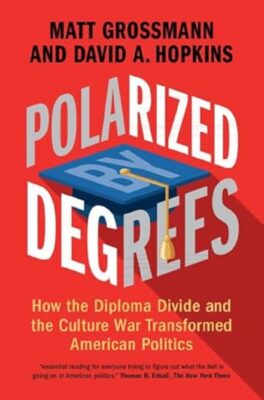
Readers know I do a monthly book roundup, where I write briefly about 4 or 5 books I’ve recently read. But every now and then, I find myself wanting to say more about a particular book. Polarized by Degrees by Matt Grossmann and David A. Hopkins is one of those.
For one, it’s timely. Most of us know there’s something wrong with U.S. politics, even at the level of everyday discussion. Things get heated and contentious. Many Americans – particularly members of marginalized groups – feel unwelcome in their own country. And we see rising levels of hate crimes, often with politicians openly egging them on.
This situation leads some of us to look for the source of the unrest. What divides us?
According to the chattering classes, especially pundits, identity forms the dividing force. We see this from both progressive and conservative ends, with the former blaming racism and/or toxic masculinity and the latter blaming the ‘woke mind virus’ or some such. It has gotten to the point where I use the term ‘identitarianism‘ to get at the assumption shared by both progressives and right-wingers that politics and/or political explanation reduce to identity.
After the dust settled from the 2024 election, people combed through the data to see how the vote broke down by demographic groups. And, of course, they brought their identitarian assumptions to the table. They wanted to know how race and gender drove the vote. Because what else could have done it?
And so they brought out the standard playbook of questions. Did Harris lose because ‘ugh, white women again!’? Did she lose because black men ‘abandoned’ her?
In Polarized by Degrees, Grossmann and Hopkins suggest something else matters more than identity.
Polarized by Degrees
Here’s how they see it. Americans are gradually sorting themselves, politically, according to whether or not they hold a college degree. Most political science accounts call for long periods of status, followed by quick bursts of change. But Grossmann and Hopkins see the degree divide as one that very slowly locked into place over decades.
On their account, the GOP used to win college graduates, and Democrats used to win non-graduates. This started changing in the 1990s. And, by now, they’ve flipped. College graduates now lean Democratic, and non-graduates lean Republican.
Grossmann and Hopkins think this happened – as the subtitle of Polarized by Degrees suggests – in response to the culture wars.
Let’s look into the details.
The Evidence
The first half of the book’s claim – that voters have sorted themselves by college degrees – is well supported by the evidence. Democrats do, indeed, gradually improve their standing with white college graduates in each election cycle, even when they do worse overall. And the GOP improves with white non-graduates, even when it does worse overall.
Compare Joe Biden to Kamala Harris for an example. Biden won 51% of white college graduates in 2020. Harris improved to 53% in 2024, even though she did worse than Biden overall (48% vs. 51%).
But we should note the word ‘white’ in those last two paragraphs. As Grossmann and Hopkins admit, this only happens with white voters. White voters are polarized by degrees, but non-white voters aren’t.
Yet, that is.
Among voters of color, Biden won 70% of voters with a college degree and 72% among non-degree holders. For Harris, the respective numbers were 65% and 64%. In other words, Harris did worse than Biden, but she did worse across the board. Voters of color did not split by education.
Why are We Polarized by Degrees?
But what about the second half of the claim? Why did voters sort themselves by educational level? And what does culture war have to do with it?
This is a mystery because the old system actually made a lot of sense. Democrats position themselves (whether accurately or not) as the party of the marginalized. Republicans claim the mantle of business and ‘rugged individualism.’
Given that, you’d expect voters without a college degree to favor Democrats and degree holders to favor the GOP. College degrees confer material advantages associated with support for the GOP. And for non-white voters, you’d expect them to vote Democratic – which they do.
But whites stand out as different.
Identitarians see this and draw the line at LBJ and Nixon. They see the 60s civil rights era as the point where things changed. Whites without degrees saw civil rights gains as a threat and started voting Republican.
The main problem with this view is that the LBJ and Nixon era weren’t when things actually changed. As recently as the Bill Clinton era of the 1990s, whites without degrees still voted Democratic.
So, we have to look elsewhere for an explanation.
Cultural Liberalism and Change
For their part, Grossmann and Hopkins acknowledge race as a factor. But they think it explains only a small part of what’s happening.
To get at the full explanation, they turn to something more general. They think white non-degree holders feel threatened by general social change. Racial inclusion forms part of that change. But it’s not only about race and women in the workplace. It’s also about neoliberal economics and globalization.
And more than anything else, gradual liberal victory in the culture wars drove non-degree holder to the GOP.
On this view, Democrats now win the votes of people comfortable with social change. These people tend to hold college degrees, which help them navigate change.
But are liberals really winning the culture wars? I suspect skeptical readers will raise an eyebrow here. We live in an era of rising hate crimes and Trumpist backlash. Revanchism seems popular now.
On the whole, though, I think Grossmann and Hopkins have a case. When we pull back and take the long view, it becomes obvious that the U.S. is a far more inclusive and welcoming place than it was in the 1960s. From interracial marriage to gay marriage, trans visibility, and cultural acceptance, the U.S. used to be a far more hostile place than it is now.
This bother many voters, particularly whites without college degrees. It formed much of the basis of Trump’s appeal. Some of these MAGA types want to ‘own the libs’ because they see a culture that has turned against their (bigoted) views.
Political Winners and Losers
Finally, Grossmann and Hopkins consider how all this ‘polarized by degrees’ stuff affects partisan politics in the U.S.
As an obvious understatement, they point to how politics defines everything now. The GOP wages war on such ‘woke capitalism’ topics as who plays in Star Wars TV shows. And on the Democratic side, politicians care more about representation or the politics of TV dramas than, say, universal health care.
But as more Americans earn college degrees – and most older voters lack college degrees – the GOP bets on a shrinking voter base. It has advantages in the Senate and Electoral College due to its focus on whites without degrees. But this also incentivizes it to focus on authoritarian politics.
Democrats, on the other hand, hold more potential to build a majority coalition. But they could face serious problems if voters of color begin to behave more like white voters. If voters of color without college degrees start turning toward the GOP, the Democrats will be in big trouble.
Cultural Liberalism and Polarized by Degrees
As leftists, this situation should frustrate us. Grossmann and Hopkins claim repeatedly in Polarized by Degrees that Democrats still support left-leaning economic views. As they tell it, Democrats merely add cultural liberalism to their slate of views.
But that’s not quite true. The authors even slip a few times and admit it.
Democrats subtly shift their economic views as they turn toward college educated voters. Rather than support comprehensive social democratic reforms, they now support targeted, liberal redistribution policies. They set aside things like job guarantees, universal health care, higher minimum wages, and union building in favor of the kinds of tax and welfare programs that don’t threaten capital or the economically advantaged.
Grossmann and Hopkins also ignore foreign policy, focusing only on domestic issues. But on foreign policy, the Democrats increasingly marginalize their anti-war, non-interventionist elements in favor of the kind of imperialist internationalism that college educated voters prefer.
And so, as a leftist, I find the Democratic Party less friendly than ever. And, let’s face it, it was never very friendly.
For leftists, the Democratic Party’s shift looks like ‘radlib‘ in action. It allows people like Gavin Newsom to pretend to support fundamental change without actually supporting fundamental change.
At the end of the day, the Democratic Party shows little interest in transforming the lives of working people and putting working people in charge.
