Alienation, autonomy, and ideology

Category: DSA (Page 6 of 8)

DSA’s Issue Is Deeper Than Jamaal Bowman

Within the Democratic Socialists of America – especially the very online parts of DSA – there’s been a hot debate lately over whether to expel Jamaal Bowman from the org. Bowman recently won an election to Congress, joined The Squad, and formed a big part of the DSA’s strategy of building membership through electoral engagement.

I won’t recap all the details. Readers can check out coverage from the DSA Observer. But the basic story: Bowman voted for Iron Dome funding for Israel. He took a lobbyist-paid trip to Israel and posed with Israel’s right-wing prime minister, among other things. In response to a rebuff from Bowman and his supporters, the DSA’s Palestine Solidarity Working Group called on him to fix these issues or face expulsion. Some on the online left sided with the WG, while other parts sided against expulsion.

But I think the whole expulsion question arrives far too late. The DSA should look into how it got into this mess in the first place.
Continue reading

How to Build a Working-Class Majority

So, we know there’s a huge political space in the U.S. to the left of Joe Biden. Many of the groups in this space talk about how to build a political majority. Progressives talk about building a coalition majority. Leftists talk about building a working-class majority.

The DSA uses the term ‘multiracial working class’ to get at its target political group. But this term raises as many questions as it answers. Each DSA faction adopts it, and then uses it in varying ways.

Where does this leave us? We don’t know what a working-class majority looks like. At least, not in any settled way. Some leftists seem to think it’s already there for the taking. Others think we need to do far more work to form it. In this post, I’ll see what the data can tell us. Is there a working-class majority out there? What does a working-class majority look like?

Continue reading

One Way DSA Caucuses Differ

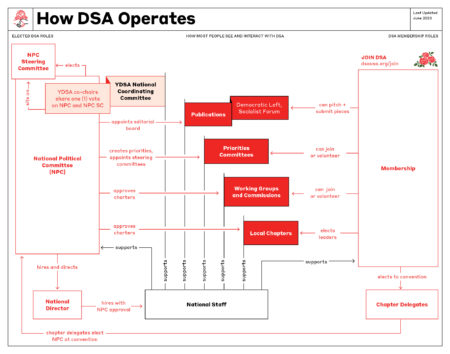
dsa caucuses org chart

So, back in 2019, I wrote a post on the different DSA caucuses. In that post, I looked only at caucus ideology as caucuses described it.

I thought about doing a similar task before the 2021 DSA Convention. But I decided against it. Why? For one, someone else already did a good job of it. Two, I thought readers might benefit from a fresh approach.

Let’s look at the DSA caucuses by how they react to problems. One specific problem, in fact. So, that’s what I’ll do in this post.

Continue reading

DSA Convention 2021: A Few Thoughts

The online version of the DSA Convention, as one might expect, didn’t have the kinds of large crowds, side debates, and raucous noise one might expect at a leftist convention with more than 1,000 delegates. But it wasn’t too far off. I’ll collect here a few thoughts about my experience as a delegate from Iowa City.

The first thing I’ll say is that the DSA Convention was still huge and a bit overwhelming. Delegates received tons of emails and discussion options. We had dozens (hundreds?) of pages of material to read on resolutions, bylaws changes, NPC candidates, and so on. Yes, it was pretty chaotic. But DSA staff did an excellent job putting materials into shape and organizing the online experience.

Continue reading

What Would the DSA Look Like if Bernie Won?

In both 2016 and 2020, the Democratic Socialists of America (DSA) went all-in on Bernie Sanders. It did so for strategic reasons. In particular, a theory drives these decisions: endorse Sanders, identify with the Bernie brand, and then gain new members from Bernie association. Maybe it doesn’t announce such things that explicitly (though it kinda does), but anyone familiar with DSA knows this was the basic idea.

Sanders lost in both 2016 and 2020. But in each case, the DSA grew enormously.

And so, in one sense, the DSA wildly succeeded. It started as a marginal organization of a few thousand mostly older leftists. It emerged as the largest U.S. socialist organization in a century, boasting around 100,000 members. Along the way, it transformed itself from a minor, largely irrelevant discussion group to a (arguably even the) major player in US leftist politics. Furthermore, the DSA grew not only in membership, but also in ideology. It grew not by tacking to the center, but rather by moving to the left. At both its 2017 and 2019 conventions, its new, younger member base pushed the org to the left.

What if, though, Sanders had won in either 2016 or 2020? What if he were president right now? In that scenario, what would the DSA look like?

Let’s take a look. I think this exercise reveals both opportunities and weaknesses in the DSA’s political model.

Continue reading

« Older posts Newer posts »