Alienation, autonomy, and ideology

Category: Activism (Page 20 of 30)

These are posts on activism from the blog Base and Superstructure. This takes many forms. The focus here is on political activism, above all on activist organizing and base-building. One concern is how to build effective movements. There’s also a need to create solidarity with fellow members and build coalitions with other groups. The main aim of good movements is to work together to advance material interests. This section also includes critiques of electoral work, and discussion of how and when to use elections to advance activist goals. Navigating the balance between grassroots work and electoral work is difficult for everyone.

One Way DSA Caucuses Differ

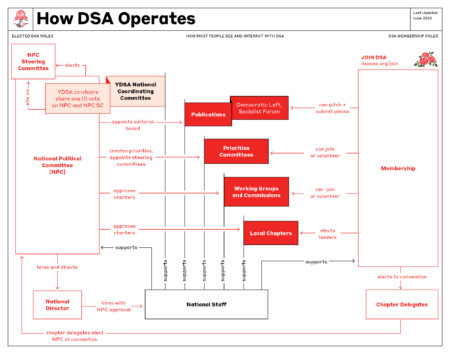
dsa caucuses org chart

So, back in 2019, I wrote a post on the different DSA caucuses. In that post, I looked only at caucus ideology as caucuses described it.

I thought about doing a similar task before the 2021 DSA Convention. But I decided against it. Why? For one, someone else already did a good job of it. Two, I thought readers might benefit from a fresh approach.

Let’s look at the DSA caucuses by how they react to problems. One specific problem, in fact. So, that’s what I’ll do in this post.

Continue reading

Should We Do What We Love?

The business literature often tells us that most people don’t like their jobs. Business leaders take a mixed attitude toward this. But what they don’t like – and what the literature also shows – is workers who are actively disengaged from their work. Among other things, disengaged workers show less productivity.

This doesn’t interest me much. As a leftist, though, I’m a lot more interested in the kind of advice the literature provides. It usually recommends a kind of propaganda campaign aimed at workers. These campaigns try to tell workers they have good jobs. They try to get workers more excited and engaged.

Maybe. But, as we know, work won’t love you back. A recent book even tells us as much. Many of us – especially white-collar workers – might consider a different strategy. Why not work a merely tolerable job, complete it quickly and efficiently, and then organize in our own time?

I think lots of people run some version of this playbook. They work a regular job and then organize with the DSA, for example.

Any readers have luck with this strategy?

Image Source

Mutual Aid vs. Charity: A False Dichotomy

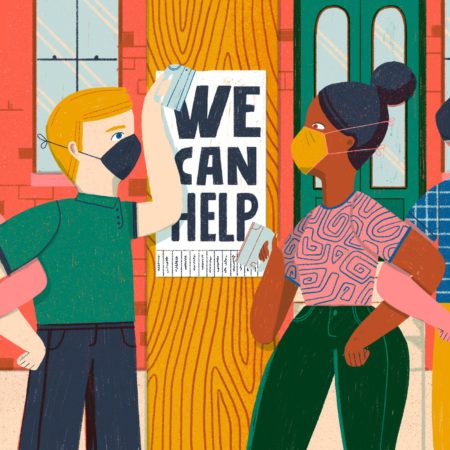
mutual aid

Most leftists know the pandemic kicked up a lot of interest in mutual aid. And most of us like mutual aid, even if we hesitate on it. Not all of us, though, which raises a few issues.

When we debate mutual aid, either pro or con, we almost always start by distinguishing it from charity. Supporters say it’s better than charity, while opponents say it’s just charity wrapped in leftist rhetoric. In other words, both sides agree that mutual aid is (mostly) good and charity is (mostly) bad. They usually disagree only on which box – ‘mutual aid’ or ‘charity’ – in which we ought to place certain projects.

I’ll take a new route here. I’ll argue that the distinction between mutual aid and charity doesn’t help us decide what to do as leftists. Why? It’s a false dichotomy, and it doesn’t cleanly map onto ‘good’ or ‘bad,’ anyway. In practice, most projects flying the ‘mutual aid’ banner use both mutual aid and charity. Often they’re a mix of the two, and at other times they’re something in between. This false dichotomy, then, leads us astray when we decide what to work on.

Let’s talk details.

Continue reading

DSA Convention 2021: A Few Thoughts

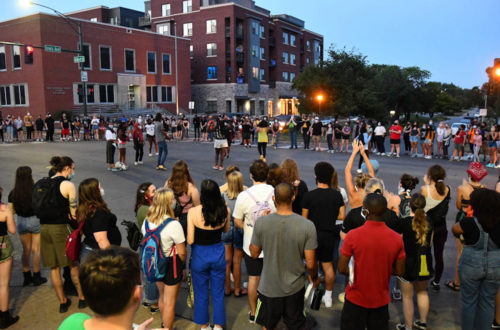
The online version of the DSA Convention, as one might expect, didn’t have the kinds of large crowds, side debates, and raucous noise one might expect at a leftist convention with more than 1,000 delegates. But it wasn’t too far off. I’ll collect here a few thoughts about my experience as a delegate from Iowa City.

The first thing I’ll say is that the DSA Convention was still huge and a bit overwhelming. Delegates received tons of emails and discussion options. We had dozens (hundreds?) of pages of material to read on resolutions, bylaws changes, NPC candidates, and so on. Yes, it was pretty chaotic. But DSA staff did an excellent job putting materials into shape and organizing the online experience.

Continue reading

What Would the DSA Look Like if Bernie Won?

In both 2016 and 2020, the Democratic Socialists of America (DSA) went all-in on Bernie Sanders. It did so for strategic reasons. In particular, a theory drives these decisions: endorse Sanders, identify with the Bernie brand, and then gain new members from Bernie association. Maybe it doesn’t announce such things that explicitly (though it kinda does), but anyone familiar with DSA knows this was the basic idea.

Sanders lost in both 2016 and 2020. But in each case, the DSA grew enormously.

And so, in one sense, the DSA wildly succeeded. It started as a marginal organization of a few thousand mostly older leftists. It emerged as the largest U.S. socialist organization in a century, boasting around 100,000 members. Along the way, it transformed itself from a minor, largely irrelevant discussion group to a (arguably even the) major player in US leftist politics. Furthermore, the DSA grew not only in membership, but also in ideology. It grew not by tacking to the center, but rather by moving to the left. At both its 2017 and 2019 conventions, its new, younger member base pushed the org to the left.

What if, though, Sanders had won in either 2016 or 2020? What if he were president right now? In that scenario, what would the DSA look like?

Let’s take a look. I think this exercise reveals both opportunities and weaknesses in the DSA’s political model.

Continue reading

« Older posts Newer posts »