Alienation, autonomy, and ideology

Category: Culture (Page 4 of 23)

These are posts on culture from the blog Base and Superstructure. Mostly the focus is on American culture. But there might be a few posts on broader, international issues.

Two Deeper Problems for the Implicit Association Test

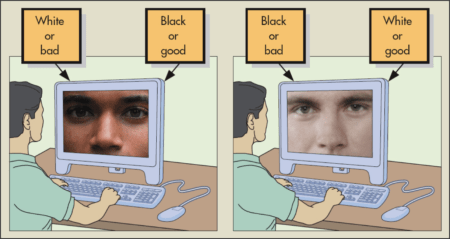
Anyone following the replication crisis (and other debates) in the social sciences knows about one key problem with the implicit association test. In short, it’s not clear whether the test predicts anything. That is to say, ‘implicit bias,’ as measured by the IAT, might not predict prejudice or discriminatory behavior.

That’s a problem for the IAT for the obvious reason that its creators intend it as a major tool in the fight against racism, sexism, and other forms of oppression.

But I want to suggest that the IAT has even deeper problems. At least two of them. Even if the IAT does predict behavior, it still doesn’t explain a lot about why racism and sexism and happen. Nor does it tells us how to fight them.

Continue reading

Working While Sick

I don’t have many lofty thoughts on the topic of working while sick. It’s just that I recently overheard someone coughing in public, and it made me uncomfortable. Not as uncomfortable as it would have in March or April 2020. But uncomfortable.

Uncomfortable in a way that it wouldn’t have made me in 2019, you know? And that takes me back to the world of the white-collar office before 2020. When people showed up to work, in-person, while sick. And they did it all the damn time.

What was with that?

Continue reading

Turning 40

On my Dad’s 40th birthday, my Mom took out an ad in the newspaper poking fun at him. I got a laugh out of it – as did the rest of my family – but the whole notion of turning 40 seemed absurd to me. 40 was just a giant number I’d presumably never reach.

Hey, I was 14. 40 was old. Now I’m turning 40 myself.

Let’s talk about that.

Continue reading

How Do Culture and Politics Connect?

This is a collage of several figures from culture and politics in the U.S.: Donald Trump, Roseanne, Jordan Peele, and Kanye.

I often write in this blog about links between culture and politics. Indeed, we’ve even got a tag for ‘culture’ (see the bottom of this post). But I’ve never tried to systematize any of this, to tell a larger story about how culture and politics connect.

We need such a story. Over the years, I’ve seen a shift on the left in how we link culture and politics. And, for the most part, it’s a shift for the worse, not the better.

As I wrote a blog post and an article on Isaac Asimov and harassment, these broader issues rose to the surface. Does an author’s work provide insight into their politics? Does our study of culture provide us with political insights? More important for our present purposes – and for trends on the left – does our critique of culture provide us with political insights or breakthroughs? And do we do politics when we make or critique culture?

Continue reading

The Star Wars Universe

Shortly before filming the prequel trilogy, George Lucas and Co. authorized a flood of new Star Wars novels. He called it the Expanded Universe (now Legends under Disney). Some were good reads, and a few (e.g., Shadows of the Empire) were great reads. But they fit together poorly. And as Lucas added novel after novel, they really didn’t work together.

By 2010 or so, the Star Wars ‘canon’ looked like unintelligible garbage. A few dozen or so authors wrote a long series of mostly self-contained stories about Luke Skywalker and friends. The stories didn’t necessarily contradict each other, but they veered wildly in terms of plot and characterization. They always added up to less than the sum of their parts.

In contrast, the Dune universe built a much more plausible franchise model. Two authors develop the plot and write each book. The Dune canon is a bit bloated, and some of the books aren’t good (and none are as good as the Frank Herbert originals), but it all fits together reasonably well.

Continue reading

« Older posts Newer posts »